
Complex Systems and Geopolitical Notes: Multipolarity, Humanity and Pathways to the 22nd Century

Summary
At present we face escalating superpower tensions that threaten nuclear conflict. This conceptual exercise compares geopolitical strategies in a multipolar world and projects alternative outcomes into the next century.
To reduce global harms and ensure the survival of humanity, policy simulations suggest a path (named Path 2 in this study) that progresses in two phases:
A policy of building trust based on neutrality, founded on a political commitment to establishing clear definitions of boundaries and limits together with a strong defensive/protective force posture.
A transition away from the present legacy system of political management and towards economic management, involving regional community choice and provision, network states and other voluntary arrangements.
Economic management also offers a means to de-escalate the puppet leadership problem whereby superpowers in a multi-polar system compete for control over politically-managed nation-states, especially in resource-rich and strategic locations. Moreover, economic management may help mitigate the risks of violence emerging from top-down “state-building” and “peace from the top” approaches which may simply replicate politically-managed entities that perpetuate pathological outcomes within economic systems (also re: Kennedy 2022 b, c, d on political management and in particular, Kennedy 2022f on econobiology).
This is a draft which may be updated from time to time. Details and examples from history are provided in the Appendix.
Introduction
Setting. We imagine a world with two or more nation-state superpowers as defined militarily, economically, resource control-wise, and to some extent culturally. Although this exercise is presented as theoretical, examples from history as well as hypothetical superpower actions are given in Appendix 1.
Defining Success. Each path has its own objectives with projected vastly different outcomes for humanity; recognizing the potentially catastrophic outcomes cannot be overemphasized. This exercise is limited to two basic paths: Path 1 is described as unipolarity at all costs, Path 2 is characterized by a striving for trust and neutrality in a multipolar context, and is divided into two future phases, one under political management/politically-managed systems, the other under economic management.
Path 1. Unipolarity at all Costs
This path seeks the progressive overt and covert destruction of competitors in countless ways with the objective being global dominance by one power and the maintenance of unipolar status at all costs.
An interventionist strategy under the guise of global leader/protector together with proclamations of undeniably laudable goals. Unfortunately, in practice this strategy can devolve into policies of “provoke, undermine, destroy” to maintain unipolarity and serve special interests (Eisenhower, 1961). This not only increases the potential for global escalation of violent conflict (Cirillo, Taleb 2016) but engenders widespread distrust, not only for possible rampant interventionism but also for the false pretenses that provide cover for the true agenda.
The global protector role may evolve over time with various overarching pretexts to protect the planet and humanity against threats but that also aim to ensure continuity while serving their special interests financially and undermining superpower competitors.
Global governance may be sought by superficially discarding the nation-state banner but while the superpower retains firm control. For this purpose, an elite group of nation-state minions must be groomed who must display their obedience to various global agendas set by a hegemon while coordinating with transnational corporations and (ostensibly) philanthropic organizations closely aligned with a superpower. Eventually, a globally-focused military and law enforcement is rolled out to punish any challenges to unipolarity and established global control agendas.
Regardless of the stated noble objectives, the pursuit of unipolarity at all costs under politically-managed systems is in practice likely to lead to violence and loss of life from the execution of these global agendas as examined in the projections below.
Note that a professed role of protector in the context of unrelenting dominance-seeking is distinct from acting protectively as a security provider in economic management, as is sketched out in Path 2 below.
Projected Consequences
Projections: Comparison of Path 1 to Potential. By 2100 significant reductions relative to potential population and income are likely tragic outcomes of this path. The deviation from potential suggests a reduction of population, GDP, and GDP per capita by roughly half (estimates ranging between 45% to 62% of potential) as seen in the three charts next.
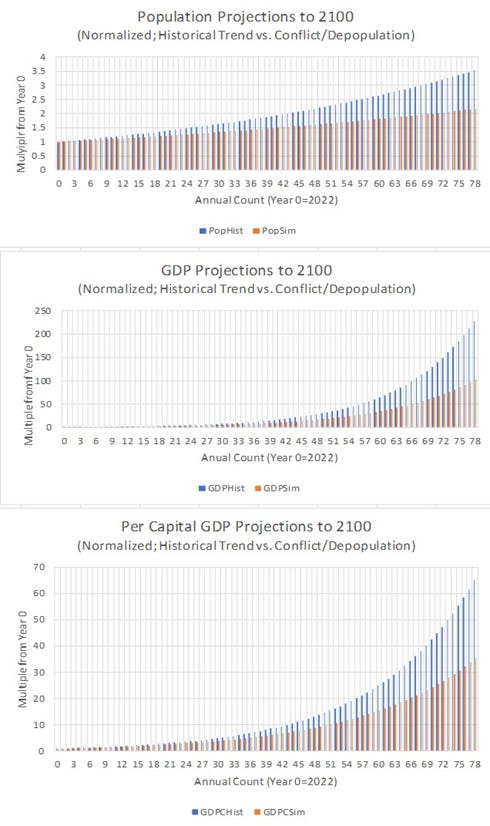
Data Sources: Macrotrends, Statista.
Chart Detail. The variables population (POP), GDP, and GDP per capital (GDPC) are each divided into alternative scenarios HIST and SIM that correspond to assumptions as follows: HIST is based on historical trends and SIM is based on Path 1 assumptions of increased conflict combined with population control agendas. The x-axis shows the annual count beginning with year 0 as 2022 and ending with the year 2100. The y-axis shows values for each year as a multiple of the base year’s figure. See Conceptual Assumptions in the next section and Appendix 2 for further details.
Conceptual Assumptions. The simulation assumes both an escalation of conflict leading to loss of life and depopulation under the guise of various ongoing and future agendas including public and “reproductive health” (re: Kennedy, Jr. and Wakefield 2022; Mangiaracina 2024 on infertility agenda). Competitive Escalation of Violence. Although only one superpower may initially be at the forefront of this approach to achieve dominance, the likelihood of brutality and genocidal behavior among and within all superpowers is expected to increase (Cirillo, Taleb 2016), even if only as countermeasures to perceived or real acts of aggression. Coercive Cost Controls. Attempts to ensure the continuity of actuarially bankrupt politically-managed entities and financially ailing transnational corporations (Andrews, et al. 2017) are expected to be part of various forms of population control measures (re: reduction of unfunded pension and health care obligations/liabilities, politically-managed (public) expenditure controls, etc. Re: Kotlikoff 2015; Mitchell 2017). These ostensible public health and other agendas may be imposed by coercive means, violation of bodily sovereignty and lack of informed consent resulting in genocide and infertility (Kennedy, Jr and Wakefield 2022; Kirsch 2022a,b; Wolf 2022; Dowd 2022; McCarthy and Sharav 2023 re: Nuremberg Code violations). Moreover, an increase in injuries, illness and suffering is anticipated as conflict-provoking policies disrupt economies and infrastructure leading to hunger and famine, lack of basic sanitation and dislocation. For further details on assumptions see Appendix 2.
Malthusianism (Malthus, 1798, 1815; Winch 1987). Malthusian thinking may be at the root of potentially deadly justifications to reduce population for overriding politically-stated reasons that may shift and evolve over time to mold public opinion. However, Malthusianism largely ignores the consequences of politically-managed systems and policies, as well as the role of economics and the historical record, and as follows:
(a) Wealth destruction. For example, extraction of income/resources of common citizens (including through currency debasement leading to reduced purchasing power) to be channeled to special interests, or to secure higher prices and profits* for politically-connected business elites by politically engineering a reduction of market supply of their goods and products.
(b) The critical role of the pricing system, prices as a signaling mechanism, and economic calculation (Mises 1920) are also largely ignored (e.g., higher prices tend to discourage the use of a resource, lower prices encourage its use; note the crucial distinction between prices that reflect reality and prices that are distorted by political interventions). Politically lowering prices through policies that encourage malinvestment and overproduction and losses involve overuse and waste of resources; in contrast, politically raising prices by causing supply and supply chain disruptions, or price-fixing/price controls can in extreme cases cause shortages, hunger and even famine.
(c) Unforeseen advances in technological progress that increase productivity of capital (Marx* 1867: McAfee, Andrew 2019), In the 19th century, previously unattainable increases in horsepower (emphasis: “horse”) and agricultural productivity were achieved by technological means not necessarily envisaged by Malthus (and Edward West) despite their immensely popular thesis and dire predictions (e.g. Haber-Bosch process; James Watt and steam engine commercialization, etc.).
*Notes
1.Note on “profits.” To clarify, this is not a condemnation of profit per se but rather highlights the fundamental problem of politically-managed distortions of profitability and costs to deliver benefits to special interests in exchange for political power and support (re: pathological profits and wealth via political management, see Kennedy 2022f on econobiology).. The special interest beneficiary of the profits is able to avoid the costs that are associated with the benefit, thereby artificially(politically) raising profits (re: Kennedy 2022 b,c,d; e.g., legal liability shield or other protections for businesses that produce harmful products, or the spraying of toxic chemicals on crops to increase yields and profitability, posing dangers for consumers, etc., O’Toole 2022).
2. Although it may be considered contradictory that Karl Marx would be cited as recognizing the essential importance of productivity of capital accumulation in economic growth (Abramovitz 1956; Kuznets 1966; Denison 1974; note that “productive capital” typically refers to tools, equipment, and machinery). The productivity of labor that derives from capital is generally recognized as a source of rising incomes as labor and capital are complements; despite their fundamental differences, this is a point upon which Marx and economists could be expected to agree (re: Mitchell 2018). It is recognized that while incomes may rise for those who remain employed the troubling question of unemployment arises, especially relevant with technological advances such as artificial intelligence and robotics (Rifkin 1996; Kurzweil 2001; re: singularity). Marx’s critical departure from economics stemmed from how the additional worker productivity from capital was to be (coercively) distributed between the capitalists and the workers. In political management, justification for forcible redistribution of incomes has arisen from this concept, including through uncontrolled debt issuance and central bank creation of money to further political objectives (re: via debt monetization). Counter-productively, these policies reduce the real purchasing power of the working class through inflation while benefiting asset holders and debtors as special interests. The resulting distortions of unstable and unsustainable politically-managed systems can lead to repeated crises and catastrophic outcomes including violent conflict as noted in this study as well as in history (Mises 1931; Ropke 1936; Barnes 1953; Lofchie 1975; Eicher 1982; Kennedy 1998; Alesina, et al. 2013, Higgs 2013; Sigurjónsson 2015; Mitchell 2017; Kennedy 2022b, c, d).
Path 2. Building Trust and Neutrality
Basics. Trust and neutrality are seen as inextricably linked. To clarify, this “neutral” position does not imply unilateral reduction of military strength (or for individuals, unilaterally reducing self-defense capabilities), or refusing to take a stance on geopolitical and geoeconomic matters. Rather, neutrality is based on clear definitions of boundaries and limits in various domains together with at minimum a strong defense posture. This will be elaborated upon furth in the Analytical Framework section below.
Defining Success. Key elements of this path towards trust and neutrality involve the adoption of basic principles to uphold and respect the following:
(a) Security and self-protection at the national, local, and individual level; note that both individual/bodily security and national/regional border security are viewed as necessary for the success of the other.
(b) seeking alternative approaches to avoid harms, death, injury and suffering of innocent civilians and non-combatants (and combatants alike wherever possible).
(c) voluntary (non-coercive) choice and interactions in productive activity and trade; property rights (as the basis for all rights, including the right of self-ownership).
(d) freedom of expression* and communications,* the right* to privacy and the right to be left alone.
Clarifications and Controversies
Fundamental concepts highlighted here include natural law, constitutional law, human rights, and rights. Also see Bastiat (1850); Napolitano (2006, 2022). An important source of confusion may exist regarding natural rights, human rights and the term “rights” as commonly used in political rhetoric; these should be clearly distinguished. A possible oversight is that the exercise of some claimed “rights” that in practice may end up negating the rights of others, involving acts of coercion, physical violence, confiscation of property or conscription to obtain access to what the “right” guarantees (United Nations 1948). Deceptive “Rights.” For example, “the right to a job” while well-meaning, could in practice mean that someone be physically forced to employ others against their will to enforce that “right.” A voluntary approach without compulsion would be to “foster an (economic) environment that is conducive to gainful employment for all.” Also, citizens must be aware of other possibly unintentional but dangerous misuses of the term “right” such as “everyone has the “right” to digital (or other) identification” (re: control grid tools, vaccine passports. compulsory digital/non-physical cashless currency systems, microchipping, etc.).
Natural and Constitutional law. A clarification should be made that it is possible for a law to be enshrined into a constitution that violates natural law* and therefore the two bodies of law are not necessarily compatible. Under a system of political management, special interest pressures (including political parties and action groups) to bypass natural and constitutional law are considered inevitable and possibly irreversible once instituted. While the judicial system in theory is expected to allow citizens to seek redress and rectify cases of anti-constitutionality, it is highly likely that under political management many adjudicators will be given priority for positions based on political reasons rather than for their allegiance to natural law and the Constitution. Moreover, law enforcement chiefs (elected or appointed) may despite their oath to the Constitution may be pressured to implement political directives that violate natural law and the Constitution or lose their jobs or chances for re-election. On historical rulings contributing significantly to the erosion of conformity with the Constitution in U.S., see McGlinchey (2024); e.g., Helvering v. Davis (1937) re: the General Welfare clause; Wickard v. Filburn (1942) re: the Commerce clause: Note that "regulate" is "to make regular" as in facilitating free trade among the states by preventing interstate trade barriers). Also see Woods 2010; Sansone 2024, re: Virginia and Kentucky resolutions, Joint Resolution of the Legislature of Wisconsin, March 19, 1859, in connection with the U.S. Supreme Court reversal of the decision of the Supreme court of Wisconsin).
Notes regarding natural law. Natural law is assumed to exist by virtue of our humanity, regardless of whether it is documented in writing somewhere. The Bill of Rights (United States of America) may be viewed as an attempt at articulating natural rights or natural law (re: Napolitano 2022b), as well as certain articles of the Universal Declaration of Human Rights (United Nations 1948) (excepting those that imply negating the natural rights of others as mentioned above). ). Property rights (re: United Nations 1948, Universal Declaration Article 17) as the basis for all rights including the right of self-ownership and by extension the natural right of security of person and self-defense (Hallbrook 2014; Njoya 2024). Regarding medical experimentation on humans and violations of bodily sovereignty, see Washington (2008); Reverby (2009) and the Nuremberg Code re: McCarthy and Sharav (2022). On natural law and societal structures see Passio (2021); on theory of universal values see Lewis (2015). Regarding a possible universality underlying the principles of nature see Kennedy (2022e; re: econobiophysics).
For an exposition of the legal foundations of natural rights and natural law, see Kinsella (2023); also see Spooner (1882). For further discussion and resources on concepts of alternative legal and justice systems, see Kennedy (2022f; re: econobiology).
It is recognized that the right to freedom of speech is subject to qualifications such as contractual breaches (which may include implied contracts) which is tied to property rights as the basis of all rights. For example, freely expressing oneself (e.g., blocking the stage, interrupting the movie or game, etc.) in front of spectators in a manner that does not conform to the rules and conditions set by the property owner for its use, as well as what was agreed upon or expected by those who contracted (e.g., gave up some of their owned resources, in other words, paid for tickets, etc.) solely to enjoy a movie or sports event in accordance with the owner’s rules for use of the property. An exception might be to “freely express” a legitimate warning to the spectators of imminent danger (e.g., fire, collapse of the stands, etc.). Setting aside the foundational matter of the legitimacy of property rights of the state, for a clarification on legal public/private property ownership distinctions as related to free speech see Napolitano (2022a).
A controversial issue also may be the extent of freedom of communications especially in a world of online digital communications with algorithmic controls: While the individual is left “free to communicate” it is possible that the network or platform forbids their message from being communicated to others due to feared loss of advertising revenues, and in some cases, money may have been paid to the network or platform to suppress the information. Although each case may be complex and contractual obligations may have notable exceptions, the ethics and dire consequences of intentionally blocking communications regarding life-saving information are evident, such as information about fatal harms suffered from a product, or a request for evacuation/rescue from a life-threatening situation or location.
Analytical Framework
The analysis of this Path 2 addresses the two distinct systems of management: Political and Economic Management.
Path 1 was discussed in the previous section and is predominantly a feature of politically-managed systems to achieve dominance in a multipolar world, regardless of the harms inflicted.
Path 2 presents a path of trust and neutrality under two systems of polarity:
1. Positive polarity as characterized by the present legacy system of political management Kennedy 2022 b, c d).
2. Negative polarity of an economically-managed system (at the global scale this is called geoeconomic management; to clarify this does not involve a system of global governance).
Path 2, System 1: Legacy System of Political Management. In a politically-managed multipolar world building trust together with a strong defensive/protective force posture (note that the ability to pivot to offensive posture cannot be dismissed) are viewed as essential. Trust and neutrality are seen as linked and founded on a commitment to neutrality. Neutrality. To clarify, this “neutral” position is not in the sense of taking no position on any matter* or unilateral reduction of military strength (or for individuals unilaterally reducing self-defense capabilities). Broadly stated, this neutrality is based on clear definitions of boundaries and limits in various domains, including property rights, geography as well as a clear separation of commercial and political matters as best as possible, while recognizing the value of free commerce (Paul 2007) towards building prosperity. Clarification of boundaries are determined by bilateral and/or multilateral negotiation and agreements among the political entities/powers concerned; more than one jurisdictional level within nation-state superpowers may be involved (Kennan, Mearsheimer 2012); ; also see Brzezinski 2016; Whitney 2023.
It should be emphasized that there is no anticipated role for an overriding global governing body which risks being hijacked, and which threatens to escalate conflict as part of a next-stage battle for control of such a global body to subjugate others.
Neutrality does not imply ignoring human rights violations by one or more of the superpowers or other nation-states/colonial powers. As part of long-term resolution, it is necessary to have a clear understanding of the historical facts and to examine how the human rights violations, if true, came about. For example, were these violations a government counter-response to a real or perceived infiltration or insurgency backed by external forces? This is a potential feature of Path 1 as detailed above.
Resolution of human rights issues may involve various approaches depending on the situation: Putting a stop to external interventions and infiltration in internal affairs/domestic political management is part of the trust and neutrality path described here. Relocation or rescue/extractions may be necessary to protect persecuted individuals or groups, although it is acknowledged that serious complications can arise when the facts reveal that the supposedly oppressed group is part of armed insurgent factions backed by other superpowers.
Although not limited just to human rights issues, a key role is seen for truly independent groups or teams of transnational and international attorneys to address multiple types of grievances and violations of rights (Boyle 2022); this does not imply the need for establishing a global government institution to accomplish this, which would lead to capture and monopoly control by special interests including nation-states seeking superpower status by this “back-door” means.
The legacy system of political management is unlikely to reduce judicial bias as court systems are politically managed and a monopoly of the state. Consequently, adjudication choice that drives a market for neutral adjudication is seen as critical components towards achieving unbiased solutions and justice (also see the section below titled Review of Economic Management and Kennedy 2022 b and c).
Building Trust. It should not be assumed that trust can ever fully be achieved in any system; at best trust is built incrementally over time through extensive experience with one’s adversaries’ or ostensible allies’ historical and ongoing behavior. In a politically-managed system this is expected to be more difficult to achieve, requiring a constant commitment that can override the pressures of special interests. For example, under political management, to abide by a trust doctrine to resolve a geographic dispute, adversaries must be fully committed to agree (even if painstakingly) to establishing the intricacies of acceptable boundaries and respecting them as best as possible, with mechanisms in place to immediately resolve perceived or real transgressions. Maintaining clear and ongoing communications is a key element of this process of trust-building.
To contrast with a simple example of an economic solution for a geographic dispute, mutual agreements may be negotiated for the purchase and development of disputed land or property via business relationships rather than pursuing continued military aggression. The issue remains of how to preserve border or surrounding security to be addressed at some point.
Transition. Ultimately the transition away from the legacy system of political management and towards economic management (on a global scale this becomes geoeconomic management) will be necessary for a self-correcting (i.e., a self-regulating system of negative polarity) sustainable civilization and the survivability of humanity. For a repetition of points made in Kennedy 2022c regarding this transitional phase, see Appendix 3.
Path 2, System 2: Geoeconomic Management. Trust and neutrality are viewed as a natural product of an economically-managed system. This is not to say that disputes and conflicts would never occur in an economic system as these are common between businesses and individuals. However, the negative polarity of the system has a self-correcting bias such that when a problem arises there is a tendency for forces to be set in motion to counteract or resolve the problem; in contrast, the trajectory of politically-managed systems tends to perpetuate or escalate problems to serve special interests that have contributed to political managers and their political parties (detailed in Appendix 1 and in Kennedy 2022f on econobiology).
Recall that at the global scale this is called geoeconomic management; to clarify, economic management practiced internationally does not involve a system of global government for implementation; as noted earlier, formation of a global entity is a potential stealth means for a nation-state to achieve superpower dominance. For background on the negative polarity of economic systems see Kennedy 2022 b, c, d.
Review of Economic Management
This is a review of features of economic management as originally presented in Kennedy 2022b,c and detailed in Kennedy 2022f on econobiology (see Table 1 and the Notes to Table 1).
Introduction. Removal of legal monopolies (regional, judicial, commercial, educational, other) allow residents and consumers the choice among competing alternatives allows economically-managed societies to function. Technological tools may be a driving force of the development of economic systems that progressively emerge outside of politically-managed systems.
Choice of Regional/Community Management Providers: Depending on the community service bundle and other contractual arrangements involved, periodic residential fees, subscriptions, or memberships are paid to regional community providers (RCPs) or regional management providers (RMPs). Some communities may be entirely self-managed and self-owned and incur the management expenses themselves and the costs absorbed by the resident owners. Since payment for these management services is directly linked to the choice of provider, or based on ownership interests*, the concept of “voting” for the provider disappears. Communities are expected to vary widely in nature, including coops, communes, resorts, self-governing homeless encampments, communities of faith or practice, communities with no particular focus, maritime communities, and eventually perhaps extra-terrestrial communities. Note on Self-Owned and Managed Communities: Ownership may also eventually be linked to digital communities and tokens, with fractionalized interests.
Choice of Security Services (typically through Providers): The community/regional manager typically contracts with security services for inside of their geographic area, likely extending outwards to their own border(s); arrangements from local to wide-area security services expands outwards to as far as national borders. Note that border and national security is a critical element of such arrangements.
Monetary/Currency Choice: Consumers choose the currency that best serves their needs (aided by future technological inter-operability. A formal distinction between currency and money is not made here). This is not an argument for the implementation of digital-only cash society which could be a feature of politically-managed attempts at control of societies. The absence of tangibility poses critical risks for security and verifiability of resource ownership (Kennedy 2022 e). Under economic management, consumers choose which type of currency/cash they wish to use, whether digital, physical or both.
Consumer Choice Permitted: Removal of legal monopoly controls including regulatory barriers allows consumers to choose from alternatives and competing producers/providers that offer their goods and services to consumers. Reversal of previously increased costs and lack of affordability with increased likelihood of quality improvements.
Adjudication Choice (Public Court System): Defendants and prosecution decide on the adjudicating judge(s) towards improving the quality of justice (unbiased outcomes via competition for neutral adjudicators; re: neutral adjudication).
Policies and Rule-Making: By the economically managed entities (see Community/Regional Management) for the communities they serve, simply replacing policies established by political management. In lieu of politicians acting as “representatives” for the electorate, attorneys/legal counsel will represent their clients individually and as groups to uphold basic rights and resolve disputes.
Technology’s Central Role. In contrast to the trajectories of political management as detailed above, the technological driving force for change is expected to be directed towards personal solutions that tend to improve options and choices. Industries that are expected to emerge and flourish from an economically centered environment are likely to be grounded in technology-assisted tools and networks towards a variety of consumer-oriented solutions including consumer-residential (community) choice, monetary choice, voluntary personal enhancement, personal defense and protection solutions, neutral adjudication options, etc. that upon broad adoption will drive further technological innovations.
For resources that address elements of economic management see Antonopoulos 2017, Gebel 2018, Srinivasan 2022; also re: intentional communities, permaculture societies, and see Kennedy (2022f; re: econobiology in the Notes to Table 1 on economic systems); also see Smith, C.H. (2022).
In Sum: In economic systems, while it is not realistic to expect total elimination of societal problems and injustices, the negative polarity of economic management has a built-in counterbalancing/self-correcting dynamic that tends to respond to problems by managing them towards resolution (Kennedy 2022 b,c,d)
Visualizing Geoeconomic Management
Analogy. How does economic management apply to a global context (i.e. geoeconomic management)? A simple but reasonably understandable analogy is that of a multi-tenant commercial center (mall) or apartment building. In this analogy, the “commercial center/mall” may correspond to a (perhaps somewhat modified) legacy nation-state, province/state or other management entity depending on geographic size and locality.
Communities/Network States as Tenants. The “tenants” within regions can be thought of as individual communities some of which can take the form of network states (Srinivasan 2022) and other structures. These prospective regional “tenants” apply for “residence” or settlement in a geographic area managed by a regional community provider (RCP). Taxes are replaced by common area management fees (CAMs) common for commercial centers or apartment buildings. The fundamental problem with taxation in legacy political management systems is discussed in Kennedy 2022 b, c. Ownership*. Some communities or states may be self-owned and managed; therefore, CAMs may not exist but the member-owner entity absorbs the costs of community operation. Some communities may already be organically established within the area (e.g., a self-governing homeless encampment) and make special arrangements for their own border security and/or contract with an RCP that covers their area.
*Note. Ownership acquisition may involve communities crowdfunding online and purchasing large tracts of land or real estate as owners and setting up their own management company corresponding to their own RCP; other communities may opt to lease land and real estate within an existing RCP owned by the RCP.
Levels of Security Provision. Under economic management security services replace the politically-managed global “protector” status as discussed in Path 1: Unipolarity at All Costs.
Multiple levels of security exist: Local (intra-community whereby in each community, in-house security services may be contracted with; Border (regional/RCP area borders) and beyond borders with wide-area security providers patrolling the periphery of the RCPs. The selected RCP provides for border security services for the local community “tenants” within their jurisdiction. Beyond the borders of the RCP, there are likely to be contractual arrangements between multiple RCPs with wide-area security services up to the existing national geographic area. Beyond existing national borders, another level of security, referred to here as transnational security could be expected to emerge. As such a market for reliable regional security develops, key personnel from national military forces may transform a portion of their activities to become providers of these services on a large scale to contractually protect regions and multiple RCPs at the same time. Regional conflict and disputes with other such regional security services may occur and bilateral conflict resolution is needed.
The above discussion is not comprehensive but sketches out how these economically-managed structures might organize and develop over time.
APPENDIX
Appendix 1: Historical View and Observations
In this Appendix, examples of strategies to maintain dominance drawing upon history as well as hypothetical scenarios and observations on the nature of political management/democratic politics are provided. This discussion is not comprehensive or fully organized as countless variations on approaches to maintain dominance at all costs exist; interpretations may differ on the historical facts.
Moral Authority. The ascension to global governance is more easily justified by a professed moral role as global protector to maintain international security in the face of nuclear Armageddon or to champion the rights and liberties of nation-states and oppressed peoples (re: Wilson 1917; Kennedy 1961). To emphasize, these goals are laudable, however the means are under scrutiny here.
Peace from the Top and War Crimes. On the deadly consequences of (possibly well-intentioned) top-down “peacemaking” by political elites/scholars with no skin in the game see Taleb (2018: Chapter 14) and on war and war crimes see Napolitano (2023); Baud (2022); also, re: “state-building” and commentary in the Summary above.
With regards to making the world “safe for democracy” (Wilson 1917), important aspects of the troubling reality of what is referred to as “democratic politics” are discussed briefly next and further in Appendix 1 (A1) of Kennedy 2022f re: econobiology; a summary definition of political management. Also see Hoppe (2022) for a critical perspective.
National Security Threats and Democratic Politics
Democracy is often proclaimed as an overriding goal of political management while dismissing the likelihood that democratic politics can pose a clear and present danger not only to national (regional) security but also to natural law and human rights, even if a constitution is in place to prevent abuses originating from said democratic politics. Sadly, it is not impossible for legislation passed by and incensed or outraged public and democratically-elected representatives to violate human rights as historical examples may attest to. Return on Political Investment. Moreover, as stated above, the pressure of special interests on the elected representatives to whose campaigns they contributed cannot be ignored given potentially outsized financial returns (Clifton 2021; Hartmann 2022; Tullock 1967, 1993; Krueger 1974 re: rent-seeking) and can in some cases sway political management in a direction that is at odds with human rights (e.g., harmful products, war, etc.). It should be added that the benefits may go beyond financial in the case of foreign powers attempting to establish a foothold in the internal political and decision-making affairs of a nation. These powerful financial and political incentives also directly relate to election integrity (i.e., elections versus “selections”) especially in an age of digitization: Granting certain selected individuals positions of power is necessary to guarantee that special interests receive the benefits they have paid for in the form of campaign contributions, etc. Ideally, the selected individuals would be those that are elected by the populace, but this may not always be possible.
Undermining Security. Another critical concern is the incentive for political managers in democratic politics to manipulate law and undermine societies to gain power as part of the key process of fundraising as well as for the mobilization of potential constituents for their party. This can be a solely domestic process or in coordination with a foreign power or foreign special interests. Relaxation of border controls to allow increased flow of human trafficking or smuggling, which can be a financial bonanza for the operators and indirectly (through front organizations) raise funds for (domestic) political campaign contributions to influence election outcomes, but that can contribute to the progressive infiltration by outside forces into a nation through the political process. Deliberate withdrawal of law enforcement not only is likely to reduce local/regional security but has benefits for special interests and political managers to seek re-election. For example, relaxing and eliminating laws on theft can allow organized theft gangs to develop and raise funds to help support the political party. Another variation may be termed “disaster capitalism” (although this may be more accurately described as the alliance between capitalists and political managers; re: corporatism; Tucker 2024) in which democratic politics push for policies that include the withdrawal of law and order, increased leniency and non-prosecution of property crimes and violence in a particular geographic area of a municipality, for example. If this strategy is successful, property values plummet in the area and local or outside interests including real estate entrepreneurs/developers (including enterprising political figures who may have had a hand in these policies) may be able to purchase the properties at a discount. Then, over time as policies driven by a public concerned by the lack of security return to law and order, the property values may rise and the insiders, among others, may be able to earn small fortunes on the real estate transactions, especially when coupled with tax-advantaged Opportunity Zones (Austin-Fitts 2023) or perhaps certain Special Economic Zones (SEZs).This democratic process can be repeated throughout the country for increased income for insider political managers and their special interests.
Criminalization and Decriminalization in Democratic Politics. A key distinction should be made between the political management of decriminalization and criminalization as vehicles for fund-raising, depending on the activity’s ability to raise funds and support for the party. For example, the decriminalization of property theft and the criminalization of drugs. In the case of drugs, criminalization may be more profitable politically to maintain the loyalty and financial support of organized drug gangs and cartels as special interests. Decriminalization of activities like this for which there is market demand would likely reduce violence between competing organized gangs fighting for geographic control for the sale of their goods (much like an alcohol distributorship in which competing businesses buy the right to sell in a particular area and no longer need to resort to violence to stake their claim (re: Prohibition era (alcohol), U.S. 1919-1933).
Political Management and Blind Obedience. The military and law enforcement play a crucial role in maintaining an oath to constitutional law that in turn aligns with natural law. However, a feature of politically-managed systems borne out by the historical record is that the objective can go far beyond essential law and order, with the imposition of tyranny and draconian policies on the citizenry. This can be achieved by the selection and mobilization of forces that tend to mechanistically follow orders without questioning the brutality involved (refer to the discussion on natural law, constitutionality, and rights). The key caveat is that politically-managed systems retain this extremely dangerous feature (re: Rummel 1997; democide).
Historical Warnings. The grave concern resides in how politically-managed systems may tend to maintain their positive polarity/feedback loop (Kennedy 2022b) to gain power including in the international arena: By sustained and deliberate, potentially deadly provocations to engineer the conditions that can then be claimed to justify more power; in other words, manufacturing crises and fearmongering to create a “need” and public support for unthinkable tyrannical actions.
Articulated by President Dwight D. Eisenhower a dual threat exists, one from the military-industrial complex* and another from a scientific-technological elite: “…we must guard against the acquisition of unwarranted influence, whether sought or unsought, or by the military-industrial complex. The potential for the disastrous rise of misplaced power exists and will persist.” (Eisenhower, January 17, 1961)
Note: A more recent version and extension of this military-industrial complex (MIC) monicker may be the MICIMATT complex, which can incorporate Congress, the Intelligence community, the Media, Academia, and Think Tanks (McGovern 2024).
More specifically, these political elites may consist of transnational corporations (e.g. defense contractors, pharmaceutical/biomedical and technology firms, or an alliance of such firms) that act as real businesses or fronts, as well as transnational charitable/philanthropic organizations (e.g. NPO, NGOs) that may fundamentally exist to serve themselves and the interests of the superpower via politically-managed arrangements to transfer wealth to themselves through various means, including via stock acquisition with media-supported market manipulations, the granting of legal immunity and patents (to pay royalties) for potentially harmful products including under the guise of public health. Corporations or organizations (colluding with nation-states) may be directly or indirectly involved in violations of human rights and genocide (Boyle 2005; 2022; also re: gain-of-function research, planned pandemics; on the Nuremberg Code see McCarthy and Sharav 2022 ) or may remain silent in the face of acts that are clearly counter to their own laudable missions.
The problem of polarity (Kennedy 2022 b,c,d) in the context of political management has been dealt with previously but key features can be emphasized here: Lack of accountability for the consequences of legislation granting legal immunity or enacting deleterious policies on individuals and small businesses that benefit big-box and online retailers or other clients of political managers (e.g., lockdown policies). In politically-managed systems it is to be expected that special interests should receive a return on their political investments in exchange for their campaign and other politically-related contributions (Kennedy 2022f on econobiology). In the absence of the public’s willingness or ability to be taxed further, the ability to create/debase the currency at will causes economic distortions, wealth inequality and the long-term stealth destruction of citizens’ incomes and savings from inflation.
Provoke, Undermine and Destroy at All Costs
Suppression of Historical Facts on Provocations. A foreign adversary may mount a counter-response to perceived (or real) threats to their sovereignty, national or even ethnic integrity (including access to vital resources). However, with a concerted and highly effective propaganda campaign and media cooperation, it is possible for a nation-state provocateur to paint a picture that the retaliating nations-state has acted aggressively without warning in an unreasonable and unprovoked manner (Roosevelt, 1941” Infamy Address”), justifying declaration of war and the professed “necessity” of the horrors that follow. (Also re: Beard 1948; Barnes 1953; Chamberlain 1953; Stinnett 2000; Unz 2023)
Intransigence without regard to Consequence. During conflict, this approach involves refusal to acknowledge or accept certain terms of cease-fire or surrender. This may be part of a policy of ultimate non-negotiation based on an unnecessarily high bar and/or unreasonable terms that become the justification for the commission of horrendous acts to “punish the enemy and put a stop to the war” despite reasonably viable alternatives (Truman, 1945; re: unconditional surrender). At this stage, the display and exercise of raw power are preferred over and above negotiated settlements or other means to reduce the cost in human lives, including unsuspecting young troops fighting in a proxy war for a superpower, innocent civilians caught in the crossfire, or the victims of damage to vital infrastructure and supply lines for essential food and energy resulting in famine. To be successful, the strategy must be followed up by suppression of information regarding this decision-making process together with credible justifications for the acts of aggression (including against civilians) as having saved “far more lives” in the end or by dehumanization of the victims (Stimson, 1947; Denson 2020; Doyle 2023; Hornberger 2023; McGlinchey 2023; Gunter 2023) and constant repetition through the educational/schooling process and mainstream/state-controlled media. It should be highlighted that historically the rhetoric surrounding "national security" may also be a pretext for foreign interventionism and imperialist designs.
Regarding perpetuation/escalation of conflict (together with perception management) in history and present, re: Barnes (1953); Cousins, Kennan (1987); Meyssan (2019); Abelow (2022); Baud (2022, 2023); Hudson (2023a,b); Johnstone (2023, 2024); Roberts (2023); Armstrong (2024).
Provocation towards Self-Destruction. Under the guise of regional security, a variation on genocidal tactics can also be intentional provocations to induce an adversary and/or allies to deploy weapons of mass destruction and nuclear war. (re: Kahn 1961; Ellsberg 2018). The consequences of such a strategy are not limited to the adversary and neighbors/allies, but can extend to the provoking superpower’s own population (i.e. national suicide).
The question here is whether there are means to avoid or minimize conflict and death, even in the face of a real aggressor. This does not imply adopting a weak military stance, only that there might be multiple reasonable alternatives, as was discussed in Path 2 in the main text.
Soft-Coup Strategies: Takeover via Backdoor Override
Soft coups and backdoor overrides involve infiltration in various ways to deceive, destabilize or foment distrust, towards eventual seizure of the political apparatus. This may be led by a superpower coordinating directly or indirectly with special interests/organizations as fronts. While soft coups may appear to avoid the violence associated with coup d’états/violent takeovers (re: Kinzer 2007; DiLorenzo 2023 re: Hawaii), they nevertheless can introduce instabilities ending in extreme violence and genocide during periods of conflict, transition and when power is fully consolidated; such backdoor takeovers can pose a grave risk to civilian populations of target countries. Also see O’Rourke (2018); Berletic (2024); re: political capture methods and imperialist expansion on behalf of special interest-clients (e.g., multinational corporations) to force open new markets and globalize consumers over local cultures and traditions.
Engineered Chaos and Division. Various types of political operations can provoke escalation of divisions and internal conflict assisted by a controlled mass media (re: divide-and- conquer strategies; driving a wedge within a group to obstruct organic group unity, fomenting conflict, etc.). Examples from history may include: The strategic drawing of geographic boundaries that exacerbates conflict to “justify” future military interventions and arms sales to benefit the military-industrial complex as a special interest client; sparking public anger through judicial decisions perceived as (or actually) unfair; politicization such that decisions and rewards are made based on power rather than by voluntary individual choices; indoctrination that emphasizes filters of reality causing people to feel justified in targeting innocents by their ethnicity, national origin, race, etc., while ignoring crimes committed by the true perpetrators due to cultivation of mental “blind spots” (also re: Nehls 2023 on the indoctrinated brain); blame-shifting to cover for actual perpetrators of heinous acts; baiting of opposing groups; propaganda of dehumanization and racism designed to justify violent actions by the state (and its supporters) against targeted citizens or foreigners at home or abroad (Gunter 2023); intentionally fomenting distrust and hatred within the populace by engineering the perception of domestic threats to provoke internal conflict.
Other Special Cases
The following analyses may be somewhat tedious but could be instrumental in saving lives and pursuing justice.
1.Engineered Attacks, Deliberate Security Breaches, and Provocations
In geopolitical and other contexts, reported attacks and atrocities must be closely scrutinized because there are asymmetric political and financial benefits to evoking a powerful public response in favor of military force/violent actions against an alleged "enemy" or targeted group, which may result in massive harm to innocents (re: the crime of collective punishment) and enable unwarranted territorial expansion under a pretext of “establishing buffer zones for security purposes,” etc.
Special interest clients of political managers may play a key underlying role in this process (i.e., the lobbying of political managers to secure contracts and funding for military/defense contractors, real estate development, the energy industry, mining, fisheries, etc.). Delivering benefits to such special interest clients can be more effectively accomplished by provoking or engineering horrific events and making false claims that serve to justify “retaliatory” actions with tragic consequences that may dwarf the horror of the initial attack.
Definitions.The attack or atrocity results in harm or death to civilians, and/or military personnel and property destruction within the jurisdiction of "N." "N" refers to a nation-state or other political jurisdiction/managed territory.
The entity "a" refers to all of those involved in the attack/crime (which may or may not extend to other parties as will be explained).
Entity "x" refers to a group that "a" is claimed to be a member of, or associated with, in some way. As will be detailed below, "x" and "a" may be conflated deliberately or unconsciously leading to untold horrors.
The objective of "N" is to garner massive and unwavering public support for a planned counter-offensive against an enemy/targeted group (which may be "x" but which can be erroneously conflated with "a").
The following gives examples of likely claims made, followed by questions to be considered:
Claim: The attack was unprovoked.
Did "N" do anything that could be reasonably interpreted as having provoked an attack beforehand? Were any clear "red lines" crossed? Were actions taken to trigger a backlash or desperation in the (would-be) attackers?
Claim: The attack involved a "failure" (of intelligence, of timely response, defense capabilities, etc.) whereby "N" ostensibly failed to protect an area that it is normally responsible for protecting (e.g., a border area).
How do we know that a claimed "failure to protect" was truly a failure, or designed to (1) allow, or (2) provoke an attack, or both (1) and (2)?
Did nation "N" have the capabilities to protect the area from attack?
Was nation "N" technologically capable of acquiring information about an impending attack? Was "N" forewarned?
If it can be concluded that (1) a clear provocation occurred and/or (2) a security breach was deliberate, a case can be made that nation "N" is complicit in the attack against its own citizens and property.
Membership and Responsibility. Other claims and questions regarding “a” and its alleged association with another group "x."
Who were the attackers? Were any of the attackers caught or identified? Did they all disappear unscathed and without a trace?
How can we be sure that “a" is not a co-opted/controlled group of individuals directed or trained (or given immunity) by nation "N"? Is group “a” being used as a tool to engineer horrific events that can be used as a pretext to retaliate for “the preservation of security” while acquiring additional land or water resources? (see Motivations below)
Claim: The attackers "a" are claimed to be members of "x," where "x" is a collection of individuals as designated by “common” characteristics (e.g., people of same/similar ethnicity, religion, race, national origin, income class, organization, political party or supporters of a political party, militants/justice warriors, protesters, rioters, trade unionists, etc.).
Conflation and Guilt-by-Association Problem. What may be overlooked is any distinction between "a" (the attackers and those complicit in the attack) and members of "x" (the "group" that "a" is deemed to be members of and which by association is assumed to be collectively complicit with "a" the attackers).
A second and difficult distinction is that many members of "x" may be very supportive of "a” which may include “a's" horrific actions (e.g., or reasons of vengeance, hatred by lived experience or indoctrination, etc., ) and believe that "a" "represents" them and their interests---however, this type of "support" does not necessarily make them complicit in the atrocities: How can we assert that all members of "x" are truly complicit with "a"?
If it can be established that "N" controls "a" (even if in a clandestine well-concealed manner), then "a" is a subset of/part of "N" and "N" can be considered complicit in the attack on its own citizens.
Determining Responsibility. By examining these claims and posing such questions, we may be able to determine whether:
(1) "N" is complicit in the attack/crime against its own citizens, and
(2) Retaliation: Any violent counter-response by "N" against "x" (recall that "x" may be conflated with "a" despite the distinction as noted above) could result in the commission of genocide of innocents.
(3) If "N" acquires land or resources owned by members of "x" in this process, "N" has also committed theft of property (see Motivations below).
(4) If by deliberate actions described above, "N" knowingly risks provoking serious conflict with other nations, "N" may be intentionally placing its own citizens as well as those of the other nations in harm’s way.
(5) If N is a client state of (an)other nation(s) (or its leadership significantly controlled by (an)other power(s)) that enable, support, and substantially provide(s) funding for N’s actions, then complicity also applies to such enabling/controlling nations.
Motivations? Given a longer-term perspective, certain motivating factors for N’s actions may eventually be revealed. Is the delivery of benefits for special interest clients involved? For example: Income for contractors (e.g., military, and other types of security-related contractors including surveillance systems, perimeter fencing, etc.). Territorial Expansion for future development plans. In retaliation against the attack, was any land or water bodies seized (re: theft)? Later, has this acquired territory been committed to development or exploitation? (e.g., residential real estate or commercial development including for tourist resorts and hotels, extraction of land-based or maritime resources such as oil or gas fields, fishing areas, uranium, lithium (re: Butler, P., 2024)). Are there any corporations or other entities associated with N or N’s ‘puppet master(s)” involved in these activities?
For additional perspectives on geopolitical developments, injustices and proxy wars leading up to late summer 2024, see Rothbard (1967), Johnson (2001) on blowback, Clifton (2021, 2024), Friedman (2023), Hall (2023), Hersh (2024), Mearsheimer (2019, 2023, 2024), Dionisio (2024), Escobar (2024), Fowdy (2024), Gordon and Njoya (2024), Hoppe (2024), Kwiatkowski (2024), McAdams (2024), Paul (2024), Sachs (2023), Schlanger (2024), Stockman (2024), Todd (2024). On regime change operations, war escalations, provocations, and attacks see: Battle (2024) (re: Scott Ritter); Berletic (2024); Billington (2024) re: Jeffrey Sachs; Alexander Mercouris of the Duran); Cunningham (2024); Executive Intelligence Review (EIR) re: “hit lists;” MacGregor (2024) (also re: Eurasia and developments); Miller (2024); Postol (2024); Small and Gallagher (2024) (re: attacks on early-warning radar systems); Schiller Institute (2024), Speed (2024), Ross (2024) on diplomacy, peace proposals, and an international security architecture).
On possible historical evidence of enriched uranium at bomb sites and genetic damage in civilian populations, re: Christopher Busby (greenaudit.org).
For more discussion on land and resource grabs, and special interest clients/political investments, see Kennedy (2022f) re: Econobiology.
2.Camouflage Insurgency Operations
Complex variations on operations are possible and one basic scenario is given here: An insurgency is developed covertly by “X” (e.g., a nation-state or superpower X) that masquerades as an insurgency coordinated by a force, group or power that supposedly no ties with X. The primary goal is to re-establish dominance over X’s puppet regime that has been showing signs of “disobedience” including by becoming too friendly with an adversary of X that we can call “Y”; this insurgency also can serve to “punish” the puppet leadership for any such transgressions as needed. The consequences of such operations can be prolonged violence and death from the engineered insurgency operations as well as violent counter-responses from the puppet regime. At some point, X can emerge as savior to “resolve differences” and “restore order”; the disobedient puppet falls back in line with X. A variation might be an insurgency that is made to look as if it is clearly backed by X’s adversary Y, causing extreme distrust of Y among X’s puppet leadership to prevent any further possible rapprochement or coalitions/alliances with Y. Controlled media and well-timed media blackouts may also be indispensable towards managing public perceptions of the events towards success of the operations.
Control of Elections. Under the current system of political management via elections, this strategy to undermine the electorate’s decisions does not necessarily involve violence although there may be accompanying so-called “color revolutions” and engineered highly-public protests to increase the perception of broad acceptance for the eventual (planned) outcome of the election(s) and the later seizure of the political apparatus in regime change operations (Benz 2023). Power Elite Preparation. A crop of individual future puppets representing multiple nations must be trained and groomed to assume political power once the election has been either falsely or legitimately won in their respective countries, with remote puppeteer handlers. Ideally this is accomplished so that multiple jurisdictions within a nation are covered (e.g., local, regional, national). With the use of digital technology and overseas servers, it is entirely possible for elections to be subject to adjustments” to alter outcomes as desired. Draining the Electorate. Critically, in politically-managed systems, given the vast amount of financial resources at the disposal of elected officials to disperse to special interests and constituents (via taxes or currency creation), a strong incentive to alter election outcomes is possible, which may naturally induce politically-managed systems to produce election outcomes with a price tag involved. The financial return on election outcomes may reach up to twenty times the original political “investment” for some industries and special interests (Clifton 2021; Hartmann 2022) The new superpower-backed political leadership and the recipients of their taxpayer-funded largesse can be considered a new power elite that progressively drains the resources of the masses in favor of special interests that made political “investments” in exchange for political “services” (e.g. campaign contributions in exchange for various policy changes that benefit them); also see Waal, Alex (de) 2016, re: political marketplace; Tullock 1967, 1993; Krueger 1974 re: rent-seeking; Stockman 2013). Resource Control. Because of the demand for inputs used in emerging technologies and products, the control of certain natural resources such as rare earths can be critical, driving superpower efforts to especially target certain countries for puppet takeovers.
Forging “Alliances” with Ulterior Motives. This is a form of subterfuge involving establishing superficially good relations with an adversary and/or ostensibly allied nations in various domains and by numerous means.
For further historical perspective on risks inherent in relationships with “friends/allies” see Sun (1917).
Special Interest Fronts: A Multi-Pronged Strategy
Special interests encompass a wide variety of entities controlled by, or with close ties to, a superpower, including entities that operate as fronts to advance superpower aims.
Global Approach. Ostensibly “global” organizations established under the guise of public health and safety are also a potential trojan horse towards eventual domination of the apparatus and governance of nation-states by political elites of an aspiring superpower and aligned special interests (which may include NPOs, NGOs and other organizations such as philanthropies acting as fronts for a superpower); also see Perkins 2005; Pastreich 2023; Kennedy, Jr and Wakefield 2022; Martin 2021, 2023, Watt 2023). Stripping of National and Individual Sovereignty. In some cases, certain organizations claiming “global” status may seek to expand power by proposing treaties with member nations that will involve loss of nation-state and local sovereignty, and an external enforcement arm to be supplied by the same or another “global” organization controlled by the superpower and corporate special interests.
Global-Local Approach. Development of a global “industry” of which the individual businesses in that industry can be established in target countries. The individual companies in the target country then form part of a new locally-based special interest group that can gain influence over target nation government policy within the target nation while collaborating internationally with other firms in the same “industry” and their governing bodies controlled by the superpower. A similar strategy can be employed with cross-border identity movements as special interests (re: identity politics). For example, this could be infiltration through cultural alignment operations (shape-shifting operations by the superpower to more seamlessly “merge” with the local culture, traditions, and events, of target nations).
Open Borders for Targeted Nations. To clarify, this commentary should not be seen as a criticism of the desire of millions of migrants for a better life elsewhere or to flee conflict in their home countries. It is recognized that political management may allow for mass (legal or illegal) immigration to bring in labor for industry and agricultural special interest clients of political managers, and to build (future) voting blocs; accordingly, a smoother transition to residency may also be politically managed (such as fast-tracking residency/citizenship through the granting of positions in law enforcement and the military or other benefits; the induction of undocumented migrants into the military with the promise of citizenship may also be intended to boost troop levels to fight in foreign wars to advance nation-state imperialist agendas).
Some immigrants (as individuals or representing special interests) may be campaign donors and therefore political investors (“clients”) of political managers to gain residency, citizenship, or other benefits. To clarify, this should not be interpreted to mean that fast-track or residency/citizenship by investment is necessarily undesirable, or that all activities or businesses operated by migrants are somehow nefarious. The principal concerns of coordinated infiltration, destabilization and violence are discussed next; however, it should be emphasized that this type of policy can just as well be entirely orchestrated from within and unrelated to migration.
Coordinated Infiltration, Destabilization and Violence. Concerns arise from such politically-managed operations that have a high probability of resulting in greater violence and fatalities. First, however, it should be clarified that most people will unfairly focus on the incoming illegal migrants as being the sole source of “the problem,” rather than the role of those orchestrating this process. Second, it is a mistake to assume that the only source of infiltration can be external; the process may be entirely orchestrated from within by indoctrinating and recruiting a particularly hostile and violent class of domestic individuals to eventually be elevated to positions of power under the controlling political managers, based upon an existing or possibly even a newly-formed doctrine/ideology.
Warning Signs. A key area to consider is whether criminal (or highly unethical) behavior tends to be systematically treated with impunity (including lack of accountability or constant inaction in the face of clear criminality). A long-term coordinated strategy may begin with security breaches (at the local and national level) by the coerced and rigged “transformation” of society of a target nation to exacerbate internal distrust, hostilities, and divisions, that ultimately serves to consolidate power by those engineering this process including through crackdowns to quell any uprising by disfavored groups. An “open border” policy may constitute just one facet of this infiltration process, as well as a ruse for other purposes, such as tacit or possibly even “backdoor” legislative approval of violent activities including involuntary human trafficking under the cover of legitimate business, charitable or protective social services. Mass uncontrolled migration policy can also provide cover for many highly fit non-citizen military-age individuals to be “mixed in” with other migrants for training and positioning in the target country, including for later deployment in “riot” cells that can be activated as needed for destabilization operations, sabotage of economic infrastructure and to foment internal conflict on cue; such activities may then be deceptively blamed on so-called “illegal migration” although the process has been coordinated from the top through a tacit policy of decriminalized trespassing.. Long-term indoctrination in the school systems to foment hate, politically-managed backing of a two-tiered justice system that treats the crimes of certain groups with extreme leniency, or intentionally bringing in individuals that have values inherently hostile to the target country and/or a tendency towards violence can also be facets of a coordinated infiltration from within or from external sources.
Other warning signs of security breaches include coordinated actions to weaken or incapacitate targeted members of the local population, notably, incapacitation of police and military forces, including by continued administration of toxic injections despite known risks, and subsequent inaction in prosecutions. Another law and order example could be systematic reduction of local merit-based hiring by intentionally discouraging potential applicants through demoralization or discriminatory practices against unquestionably qualified individuals, followed by replacement by large numbers of hostile and violent individuals. Thefts of large quantities of potentially explosive (e.g., ammonium nitrate), highly toxic, or other materials, systematic train derailments, unexplained factory fires and explosions should also be treated as a major security matter, particularly if such incidents are systematically left uninvestigated. As societal conditions continue to be perceived as worsening, honest and concerned local citizens may justifiably protest or become more vocal about protecting their communities; in response to such community voices, if political managers and the authorities denounce or suppress citizens rather than address their concerns, this is another warning sign. Another possible component of a long-term infiltration strategy can be coerced reduction of a target population via inducement of infertility without informed consent. Moreover, societies can be systematically remolded towards a propensity towards violence through indoctrination of young people in the politically-managed school systems, rooted in teaching youth to despise certain targeted groups (e.g., targeting by religion, race, ethnicity, traditions, values, political beliefs, national origin, income class, etc.) and to embrace a new doctrine advocated by political elites (and their controlled media) for the perpetuation of control, and advancement for the followers of the new doctrine (Lasch 1996). A new crop of the fiercest adherents to the doctrine can then brought into positions of power, adding a layer to the existing power structure to be weaponized against others and forming a larger buffer between the elites who remain firmly in control and the targeted groups they wish to be subjugated.
Credit extension can be designed to perpetuate dependency of target nations on the superpower’s currency and debt denominated in the currency which supports the financial institutions of the creditor nation; if the debt becomes unrepayable and the target country defaults, contractual arrangements may compel the country to remain in the superpower’s orbit and give up sovereignty and control of the indebted assets/infrastructure to the superpower or its transnational corporations. Bailouts and other financial strategies may also be offered and employed as part of a “carrot and stick” strategy as well.
Threat Apparatus: Technological Weaponry. With technological advances, a superpower may threaten (but refrain from) deploying advanced tools against both enemies and allies alike to project power and force compliance, or actually deploy such tools as punishment for acts of "disobedience" against a superpower's directives. The list is non-exhaustive but may include (current, future) technological weaponry in various domains: Geophysical and atmospheric engineering (e.g., earthquakes, tidal waves, storms, tornadoes, drought/flood, etc., re: Wigington, 2017), biological (bioweapons)/chemical weapons (Boyle 2005, 2022; Martin 2023; Kennedy, Jr. 2023), radiological, directed energy weapons (DEWs), advanced nanotechnological, neurological and psychological operations, drone-assisted and other forms of infrastructure destruction (financial, energy,/transportation, food, manufacturing, etc.), activation of riots (cells), etc. On the targeting of allied nations’ currencies/financial systems see Luongo (2023); on incapacitation of energy and energy-dependent productive infrastructure of allies see Chossudovsky (2023). For historical instances of suspected punishment against allies who go “off-script” or of refraining from taking certain violent actions to ensure compliance see Hudson 2023a; Krainer 2023)
Psychological warfare against targeted political and other figures may also be employed as part of the strategy to play competing superpowers against each other and exert dominance, including against domestic populations (Desmet 2022: Hughes, et al., 2022). This can include the weaponization and abuse of the field of psychology for political purposes as needed for particular operations (Reich 1983 re: USSR; Corbett 2023).
The backing of certain celebrities and influencers can also play a role, as well as blackmail (Webb 2022). On propaganda (perception management) see Ellul (1962), Herman and Chomsky (2002), Hopkins (2022), Pilger (2022), Baud (2023), Taibbi (2023) and on its invisibility see Johnstone (2023).
Concluding Remarks on Path 1. In sum, a Path 1 policy that continues indefinitely and further degenerates into “provoke, undermine and destroy” to attain unipolarity at all costs may threaten humanity far beyond what we may have already seen in history (Fein 2010; Nimmo 2023; Smith, D.M., 2023; Watson Institute 2023a,b).
This grim conclusion based on a Path 1 scenario may be supported by the devastating results of the projections to 2100 presented in the main text above (further details are provided in Appendix 2 next).
Appendix 2: Projections Assumptions Detail
The simulation considers tail risks of violent conflicts (Cirillo, Taleb 2016) and makes assumptions that incorporate historical factors such as war (including war on civilian populations)* Re: The Morrill Tariff 1861/protectionist platform, Lincoln addresses 1861 (also re: Corwin Amendment), 1863, DiLorenzo (2007); Addicott (2023). Also see Brave Heart and DeBruyn (1998); Hallbrook (2014); Zinn (2015); Rwandan genocide 1994; Whitehead (2022); Smith D.M. (2023); Watson Institute (2023a,b), Martin (2023), genocide/democide including engineered famines (Rummel 1997), and other policy origins of famine of the 20th century (re: Rake 1975; Lofchie 1978, Eicher 1982).
(*) Note that the term “civil war” may serve to de-emphasize the role of central state-sponsored violence against civilian populations.
Assumptions also incorporate anticipated politically-driven infertility and other population-reduction agendas under various guises including public and “reproductive health” through stealth vaccination (re: conjugate vaccines, lack of informed consent; Kennedy, Jr and Wakefield 2022; Nascimiento 2023; Mangiaracina 2024). Also see Martin 2021, 2023; Dowd 2022; Hughes, et al. 2022; Kirsch 2022a, b; Wolf 2022; Chudov 2023 (re:Earth4All, Club of Rome and The Limits to Growth 1972; Watt 2023).
The growth assumptions for each variable are compound annual growth rates (CAGR) as follows: Population growth at the long-term trend of 1800 to 2022 (this rate of growth is roughly 62% of the more recent trend from 1950-2022 to approximate a long-term reduced growth scenario); GDP growth (nominal) to 85% of trend from 1960-2022; and GDP growth per capita (nominal) to 85% of trend from 1960-2022. The question may arise how these assumptions result in such precipitous drops in these variables by the year 2100; this stems from the destruction of compounding growth over time (i.e., growth emerging from previous growth, successively), even where small reductions are assumed in the rate of compounding.
Appendix 3
Transition from Legacy System Dependency to Self-Sufficiency (Kennedy 2022c and in particular Kennedy 2022f on econobiology; also, re: parallel economic systems). In the breakdown of politically-managed systems and transition to economic activity, there is a restoration of real income to those from who it was extracted along with a reduction of the income of beneficiaries of the politically-managed system. Because by the later phases the system has typically expanded to the point that much of the population has become dependent as beneficiaries through the redistribution subsystem and special interest benefits, there is a complex dislocation and reallocation process involved. In advance of this eventuality, for most of the population regardless of (former) beneficiary status, building some level of self-sufficiency including having marketable skills, services, or goods to offer is seen as vital for when the politically-managed system can no longer be relied upon.
These results are shared as a public service; if helpful consider paying it forward by adding something extra to any donations made to reputable charities, preferably with priority given to the most vulnerable, including defenseless animals. Organizational reputations may be researched through sites such as charitynavigator.org.
The author may also hold positions in securities of companies, including through ETFs, which may have been covered herein. The discussion and any visuals may contain significant errors, are subject to revisions and are provided 'as is' solely for informational purposes, not for trading or investment advice. This preliminary analysis is exploratory; no claims are made as to the validity of data, assumptions, theoretical models, and methodologies; results may be based on prior data that do not reflect the most current market or other events.
REFERENCES
Notes: Many of the references listed here may be unrelated to the topic of this study as they have been carried forward from other studies by the author. Online references may exclude “https.” Some dates may vary slightly according to time zone differences. If a date is not clearly indicated in an online reference, the most recent year of access will be shown. If an author name is not made available for a page (online), either the online publication name or the name of the principal individual being covered is used. The citations or references does not imply endorsement or agreement with a source or author’s views, or that the authors cited or referenced would endorse or agree with this author. Some authors may have been subject to ideological or politically-motivated purges including their untimely death, or the ‘disappearing’ of their works. Retractions of peer-reviewed and other studies may occur due to controversy arising when the findings conflict with predominant and accepted narratives rather than the quality of the research; it should also be added that in certain cases such authors and researchers may also be subject to widespread “smearing” and character assassination attempts online and elsewhere. Sources cited may be from mass-distribution publications and some studies may not be peer-reviewed; authors may be listed in references according to the order shown in the study and not alphabetically. These references are not a comprehensive listing of resources on the topics covered. Universal Framework. The framework of political management developed by the author draws from historical observations centered on the U.S. However, the intention is for the framework be used as an analytical tool for any other politically-managed entities (e.g., nation-states) and time periods. Therefore, application of the framework is not seen as limited to a single politically-managed entity or period.
Abelow, Benjamin., How the West Brought War to Ukraine: Understanding How U.S. and NATO Policies Led to Crisis, War, and the Risk of Nuclear Catastrophe, Siland Press, 2022.
Abramovitz, M., "Resource and Output Trends in the United States since 1870," American Economic Review, Papers and Proceedings, May 1956.
Adams, Milan., "How Many September 11ths has the United States Caused in Other Nations since WWII?, preppgroup dot home dot blog, May 26, 2024 (also re: Watson Institute).
Addicott, Jeffrey., Union Terror: Debunking the False Justifications for the Acts of Terrorism Waged against Southern Civilians in the American Civil War, Shotwell Publishing LLC, 2023 (also see DiLorenzo 2007; Zinn 2015).
Alesina, Alberto and Giavazzi, Francesco (Eds.), Fiscal policy after the Financial Crisis, National Bureau of Economic Research (NBER), University of Chicago Press, 2013.
Amnesty International (see United Nations, General Assembly 1948).
Andrews, Dan., McGowan, Muge Adalet., and Millot, Valentine., “The Walking Dead? Zombie Firms and Productivity Performance in OECD Countries,” OECD Economics Department Working Papers No. 1372, January 10, 2017.
Antonopoulos, Andreas M., The Internet of Money, (Vol 1, 2) Merkle Bloom LLC, 2016, 2017.
Arendt, Hannah., Totalitarianism, Houghton Mifflin Harcourt Publishing, 1968.
Aristotle (c. 350 B.C.)., Politics, Book III, Chapter 16, Oxford University Press, 2009.
Armstrong, Martin., "Why War is Inevitable & the Outcome," Armstrong Economics dot com, March 1, 2024.
Ateba, Simon., "Dr. David Martin Claims COVID-19 Pandemic Was Pre-Meditated Domestic Terrorism, Speaks at European Parliament Summit," Today News Africa, May 28, 2023. //todaynewsafrica.com/video-dr-david-martin-claims-covid-19-pandemic-was-pre-meditated-domestic-terrorism-speaks-at-european-parliament-summit/ (also see Martin 2021).
Austin-Fitts, Catherine., “Banking Insider: Why the Culling was Inevitable,” (transcript; interview by Taylor Hudak), Journey to a Better Life, pennybutler dot com, April 25, 2023.
Baldwin, Chuck., "The War Criminal and Mass Murderer that Many Evangelical Leaders Adored,” LewRockwell dot com, December 11, 2023. (also, re: Grandin 2016, Hitchens 2012).
Bank for International Settlements (BIS), "Global Financial Markets Remain Dependent on Central Banks," Chapter II, BIS 85th Annual Report 2014/15, June 28, 2015, pp. 25-43.
Barnes, Harry Elmer (Ed.)., Perpetual War for Perpetual Peace, Caldwell, Idaho: The Caxton Printers, 1953. (also see: Chamberlain, William Henry, Chapter 8); Authors: Dr Charles Callan Tansill, Dr Frederic R Sanborn, Dr. William L. Neumann, George Morgenstern, Percy L. Greaves, Jr., William Henry Chamberlin, and Dr. George A. Lundberg.
Barnett, Gary., "The Cultural Decline of America and the West, and the Ensuing End of Tradition and Liberty,” lewrockwell dot com, April 11, 2023.
Barro, Robert J., "Are Government Bonds Net Wealth?", Journal of Political Economy (Vol. 82, no.6), University of Chicago, Nov/Dec 1974.
Bar-Yam, Yaneer., Garcia, Rodolfo., Langlois-Meurinne, Jean., Kawakatsu Mari., “Preliminary Steps toward a Universal Economic Dynamics for Monetary and Fiscal Policy,” ArXiv; 1710.06285 (Dec 2017).
Barua, Akrur., Buckley Patricia., “Rising corporate debt: Should we worry?” Issues by the Numbers in Deloitte Insights, April 2019
Barzun, Jacques., From Dawn to Decadence: 1500 to the Present: 500 Years of Western Cultural Life, 1st Ed., Harper Perennial, 2001.
Bastiat, Frédéric (1850)., The Law, Tribeca Books, 2015.
Battle, Stewart., "Scott Ritter Responds to NATO Escalations Against Russia," Executive Intelligence Review (EIR), eir dot news, June 1, 2024. (also see MacGregor 2024, Small and Gallagher 2024, Cunningham 2024).
Baud, Jacques., “The Road to War,” The Postil Magazine, April 1, 2022.
Baud, Jacques., Governing by Fake News: International conflicts, 30 years of infoxes used by western countries, Max Milo Publishing, 2023.
Bauer, P.T., Equality, the Third World and Economic Delusion, Harvard University Press, Cambridge, Massachusetts, 1981.
Baumol, W.J., Bowen, W.G., "On the Performing Arts: The Anatomy of Their Economic Problems,” The American Economic Review, Vol. 55, No 1/2. (March 1965), pp. 495-502.
Beard, Charles., (1948) President Roosevelt and the Coming of the War, 1941, Routledge, 2003.
Becker, Gary., The Economic Approach to Human Behavior, Chicago: Chicago University Press, 1976.
Bell, Thomas., “The Rule of Law,” in Mitchell, Daniel., "The Constitution, Rule of Law and the Power of the Political Class,” International Liberty, June 5, 2014.
Bennett, Charles., “Dissipation, Information, Computational Complexity and the Definition of Organization,” in Emerging Syntheses in Science (ed. D. Pines, Addison-Wesley, Boston), 1987.
Benson, Bruce L., The Enterprise of Law: Justice Without the State, Independent Institute, 2nd Edition, 2011.
Benz, Mike., (MikeBenzCyber, Transition Integrity Project, color revolution planning), interview with Benny Johnson, X (formerly Twitter), Timestamp 2:40 pm, December 13, 2023.
Berletic, Brian, "Modern American Imperialism Part 1: US Political Capture as a Game (& How to Win)," The New Atlas Channel, Youtube dot com and t dot me (brianlovethailand/2953), May 22, 2024.
Berletic, Brian., "US Elections & Continuity of Agenda," Brian Berletic's New Atlas Channel, Youtube dot com; t dot me (brianlovethailand), July 28, 2024 (re: continuity of policy across presidential administrations, U.S.).
Berletic, Brian., "Who Really Controls US Foreign Policy?" New Eastern Outlook, August 7, 2024 (on think tanks and their sponsors, and academia as drivers of foreign policy).
Berman, Harold J., Law and Revolution: The Formation of the Western Legal Tradition, Harvard University Press, 1983.
Bezmenov, Yuri., (1984), see Ratner, Paul (2023), also re: Antonio Gramsci.
Billington, Michael., "Prof. Sachs: The UN Must Act on the U.S.-Run Coups in Pakistan and Bangladesh," eir dot news, August 19, 2024 (citing Alexander Mercouris: "Duran's Mercouris on Bangladesh Coup as a U.S.-Run 'Maidan’,” eir dot news, August 19, 2024).
Bird, Richard., Taxing Agricultural Land in Developing Countries, Harvard University Press, 1974.
Bohm-Bawerk, E. von., “The Function of Saving” Annals of the American Academy of Political and Social Science (May 1901).
BIS, see Bank for International Settlements.
Borio, C. and Disyatat, P.., " Low Interest Rates and Secular Stagnation: Is Debt a Missing Link?" VOX, June 2014.
Bovard, James., Last Rights: the Death of American Liberty, The Libertarian Institute, 2023.
Bowles, Samuel., Kirman, Alan., Sethi, Rajiv., "Retrospectives: Friedrich Hayek and the Market Algorithm," Journal of Economic Perspectives (Vol. 31 No. 3), Summer, 2017 (pp. 215-30).
Boyle, Francis A., Biowarfare and Terrorism, Clarity Press, 2005.
Boyle, Francis A., World Politics, Human Rights, and International Law, Lexington Books 2021.
Brave Heart M Y., DeBruyn, L M., “The American Indian Holocaust: healing historical unresolved grief," Am Indian Alsk Native Ment Health Res, 1998;8(2):56-78.
Brainard, Lael., "Normalizing Monetary Policy When the Neutral Interest Rate Is Low," Presentation at the Stanford Institute for Economic Policy Research, Stanford, California, December 1, 2015.
Brose, Christian., The Kill Chain: Defending America in the Future of High-Tech Warfare, Hachette, Books, 2022.
Brown, Gilbert., “Agricultural Pricing Policies and Economic Growth,” Finance and Development, December 1977.
Brzezinski, Zbigniew., “Toward a Global Realignment,” The American Interest, Vol 11:6, April 17, 2016.
Buisseret, Anna (de)., re: crimes against humanity; archived File (Audio)/web.archive.org/web/20220122014627/https://bluecat.media/biggest-crimes-against-humanity-ever-committed-anna-de-bouisseret-explains-who-will-be-held-liable-under-the-law/ (2022)
Burja, Samo., “Why Civilizations Collapse,” samoburja.com and The Side View, August 19, 2020.
Busby, Christopher., greenaudit.org on historical evidence of enriched uranium and genetic damage in civilian populations, other research.
Butler, Phil., "The EU is Willing to Go to War over Lithium?", LewRockwell dot com (New Eastern Outlook), January 3, 2024.
Cairncross, A.K., Factors in Economic Development, London, Allen and Unwin, 1962.
Cantillon, Richard., Essai sur la Nature du Commerce en Général (traduit de l’anglais), 1755.
Carden, James., "NATO's Bridge to Nowhere," theamericanconservative dot com, July 12, 2024.
Carroll, Michael C., Lab 257: The Disturbing Story of the Government's Secret Germ Laboratory, William Morrow, 2005. (Re: Lyme Disease; also see Newby 2020).
Carty, Anthony., The History and Sovereignty of South China Sea, New Star Press, 2023 (also re: Global Times interview April 6 2024; //www.globaltimes.cn/page/202404/1310059.shtml).
Casey, Doug., "The End of the Nation-State," International man dot com, Accessed December, 2023.
Chamberlain, William Henry., "How Franklin Roosevelt Lied America into War," Chapter 8 in Barnes, Harry Elmer (Ed.) (1953).
Christ, Carl., “A Simple Macroeconomic Model with a Government Budget Restraint,” Journal of Political Economy 76 (1) (Jan/Feb 1968), 53-67.
Christ, Carl., “On Fiscal and Monetary Policies and the Government Budget Restraint,” The American Economic Review 69(3-5) (1979), 526-538.
Chossudovsky, Michel., The Globalization of War: America's ''Long War'' against Humanity, Global Research, 2015.
Chossudovsky, Michel., "U.S. Act of War Against the European Union," lewrockwell dot com, March 27, 2023. (regarding currency/financial aspect vs. allies, see Luongo 2023).
Chudov, Igor., " 'Giant Leap' -- a Plan to Reduce Birth Rates by 81% in the Next 70 Years," Igor's Newsletter (Substack), November 21, 2023.
Chung, Cynthia., The Empire on which the Black Sun Never Set: The Birth of International Fascism and Anglo-American Foreign Policy, Independent, 2022.
Cirillo, Pasquale., and Taleb, N.N., "On the Statistical Properties and Tail Risk of Violent Conflicts," Physica A: Statistical Mechanics and its Applications 429, 252-260, 2016 (re: Tail Risk Working Papers, ArXiv, Oct 19, 2015).
Clarida, Richard., “Removing Accommodation” PIMCO Global Central Bank Focus, March 2017.
Clausewitz, Carl von., On War (Indexed Edition), Princeton University Press, 1989.
Clifton, Eli., “Top defense firms spend $1B on lobbying during Afghan war, see $2T return,” Responsible Statescraft, September 2, 2021.
Clifton, Eli, “Gaza policy risks re-election but pleases wealthiest donors,” Responsible Statescraft, responsiblestatecraft dot org, May 16, 2024.
Codevilla, Angelo., “To Rescue a Nation,” The American Mind, June 22, 2021.
Cook, John. D., “Thick Tails,” John D. Cook Applied Mathematics Consulting (johndcookDOTcom), January 18, 2008.
Cooke, Roger, et al., Fat-Tailed Distributions: Data, Diagnostics and Dependence, Wiley-ISTE, Vol. 1, 2014.
Corbett, James., "James Corbett on the Weaponization of Psychology," Antijantepodden podcast ajp.fm (AJP92), July 26, 2023. (also see Reich 1983)
Cousins, Norman., Kennan, George (foreword)., The Pathology of Power, W.W. Norton & Co., 1987.
Coyne, Christopher and Coyne, Rachel (Eds.)., Flaws and Ceilings: Price Controls and the Damage They Cause, Institute of Economic Affairs, 2015.
Creveld, Martin (van), The Rise and Decline of the State, Cambridge University Press, 1999.
Crooke, Alastair., Resistance: The Essence of the Islamist Revolution, Pluto Press, 2009.
Crooke, Alastair., “The ‘Last Man’ Teleology and the Fall of the West,” Strategic Culture, September 25, 2023 (also re: Christopher Lasch 1996; Gordon Hahn).
Cunningham, Finian., " Geniuses Macron and Scholtz make the argument for Russia to strike NATO members," Strategic Culture Foundation, strategic-culture dot su, May 30, 2024.
Cunningham, Finian., "Myanmar’s civil war: A golden opportunity for U.S. sabotage of China’s interests," Strategic Culture Foundation, strategic-culture dot su, June 7, 2024.
Cunningham, Finian., "NATO and its Kiev proxy in last roll of the dice," strategic-culture dot su, August 13, 2024 (on threat of nuclear terrorism, nuclear extortion; also see Miller 2024).
Curtin, Edward., edwardcurtin dot com, July 3, 2024 (also re: Pinter, Harold 2005).
Deace, Steve., Horowitz, Daniel., Rise of the Fourth Reich: Confronting COVID Fascism with a New Nuremberg Trial, So This Never Happens Again, Post Hill Press, 2023.
De La Calle, L.S., (1544) Instrucción de Mercaderes ... (see Grice-Hutchinson 1952) (Re: School of Salamanca)
Denison, E.F., Accounting for US Economic Growth 1929-69, Washington, Brookings Institution, 1974.
Denson, John., "The Hiroshima Myth," Mises Daily Articles, Mises dot org, August 6, 2020. (also re: James Byrnes, Truman administration)
Desmet, Mattias., The Psychology of Totalitarianism, Chelsea Green Publishing, 2022. (also re: Hughes, et al., 2022).
Devajaran, Shantayanan, and Anthony C. Fisher., “Hotelling’s Economics of Exhaustible Resources: Fifty Years Later,” Journal of Economic Literature Vol. XIX (March 1981), 65-73.
De Waal, Alex (see Waal; re: political marketplace).
DiLorenzo, Thomas., Lincoln Unmasked: What You're Not Supposed to Know About Dishonest Abe, Forum Books, 2007.
DiLorenzo, Thomas., "Hawaii's 'Bayonet Constitution'," Lewrockwell dot com, August 25, 2023.
Dionisio, Hugo., "Being a US Ally Means Silently Watching Your Own Destruction," The Cradle, thecradle dot co, May 8, 2024.
Dixon, Peter B. and Jorgenson, Dale., Handbook of Computable General Equilibrium Modeling, Volume 1A, Elsevier North Holland, 2013.
Douady, R., and N.N. Taleb., "A Map and Simple Heuristic to Detect Fragility, Antifragility, and Model Error," arXiv Preprint, 2012.
Dowd, Ed., "Cause Unknown": The Epidemic of Sudden Deaths in 2021 & 2022, (Children’s Health Defense), Skyhorse, (publication scheduled December 13, 2022).
Doyle, C. Joseph., “Nagasaki: An Act of State Terrorism,” The Postil Magazine, September 1, 2023 (also re: Hornberger 2023; Busby, Christopher greenaudit.org).
Dulles, Allan., (1966) The Secret Surrender, Harper & Row, 1966; UNKNO, 2006.
Ehret, Matthew., Chung, Cynthia., Clash of the Two Americas Volume 4: The Anglo-Venetian Roots of the Deep State, Independent, 2023.
Eicher, Carl K., “Africa’s Food Crisis,” Foreign Affairs, Fall 1982.
Eisenhardt, Kathleen M., “Agency Theory: An Assessment and Review,” Academy of Management Review (Vol 14, No. 1), 1989, pp. 57-74.
El-Erian, Mohamed., The Only Game in Town: Central Banks, Instability and Avoiding the Next Collapse, Random House, New York, 2016.
Eisenhower, Dwight D., “Farewell Address: Military-Industrial Complex,” January 17, 1961. (Note: “Scientific” reportedly redacted from the term).
Elborno, Lara., see Hall (2023).
Ellsberg, Daniel., The Doomsday Machine: Confession of a Nuclear War Planner, Bloomsbury Publishing, 2018. (also see Kahn 1961).
Ellul, Jacques., (1962) Propaganda: The Formation of Men's Attitudes, Vintage, 1973.
Escobar, Pepe., “The Ukraine Charade, Revisited,” Strategic Culture, January 19, 2024.
Escobar, Pepe., "Supporting genocide to halt multipolarity, The Cradle, thecradle dot co, June 6, 2024.
Escobar, Pepe., "China Throws Clout Behind Palestine," The Cradle, thecradle dot co, July 27, 2024. (re: Beijing Declaration, diplomatic outcome uniting Palestinian factions).
Executive Intelligence Review (EIR), “’Countering Disinformation’ by Assassination: Lesson of the Fico Hit,” larouchepub dot com, EIR Vol. 51, No. 22, May 31, 2024.
Fabozzi, Frank J., and Modigliani, Franco., Capital Markets: Institutions and Instruments, Prentice-Hall, Inc., 1992.
Fama, E., and Jensen, M., “Separation of Ownership and Control,” Journal of Law and Economics (26: 301-325), 1983.
Fanon, Frantz., (1961) The Wretched of the Earth, Grove Press, 2021.
Fein, Bruce., American Empire Before the Fall, CreateSpace Independent Publishing, July 4, 2010.
Fellman, Philip Vos., Bar-Yam, Yaneer, Minai, Ali A., Editors., Conflict and Complexity, Springer, 2016.
Ferguson, Niall., The Great Degeneration, Penguin Books, 2014.
Ferguson, Niall., "How Great Powers Fall," Newsweek, December 7, 2009 (41-44).
Fetter, Frank A., "Interest Theories, Old and New," The American Economic Review, Volume IV, No. 1 (March 1914), 68-92.
Fisher, Irving., The Rate of Interest (New York: Macmillan, 1907).
Fisher, I., The Theory of Interest (as Determined by Impatience to Spend Income and Opportunity to Invest It), New York: The Macmillan Company, 1930.
Fitzgerald, Maggie., “Amount of global debt with negative yields balloons to $15 trillion,” cnbc.com, Aug 7, 2019
Forrester, Jay., “Counterintuitive Behavior of Social Systems,” Technology Review 73 (3) 52-68, 1971.
Fowdy, Tom., "The Real Reason Behind the US 'Port' in Gaza," globalreserarch dot ca, March 17, 2024.
Friedman, David D., Law's Order: What Economics Has to Do with Law and Why It Matters, Princeton University Press, 2001.
Friedman, David D., "Palestine," David Friedman's Substack, (Substack), October 26, 2023 (re: policy of group rights vs. individual rights in property ownership; also see Rothbard, 1967).
Friedman, Milton., Price Theory, Walter de Gruyter: Aldine Publishing Company, 1986.
Ganser, Daniele., USA: The Ruthless Empire (German: Imperium USA: Die skrupellose Weltmacht), Skyhorse, 2023.
GAO (see General Accounting Office).
Gatto, John Taylor., The Underground History of American Education: A School Teacher's Intimate Investigation into the Problem of Modern Schooling, Odysseus Group, 2000.
Gebel, Titus., Free Private Cities: Making Governments Compete for You, Aquila Urbis, 2018.
Giordano, James., Neurotechnology in National Security and Defense: Practical Considerations, Neuroethical Concerns (Advances in Neurotechnology), CRC Press, 2014.
Glennon, Michael J., National Security and Double Government, Oxford University Press, 2016 (also re: Hornberger, 2023)
Goldberg, Jonah., Liberal Fascism, Crown Forum, 2009. (Also, re: Sowell 2007, 2010; Tucker 2017).
Golinger, John., "Ignoring the Citizens United elephant-in-the-room," The Hill, January 19, 2024.
Gordon, David., Njoya, Wanjiru., "The Classical Liberal Case for Israel," LewRockwell dot com, February 2, 2024.
Grandin, Greg., Kissinger's Shadow: The Long Reach of America's Most Controversial Statesman, Picador, 2016. (also, re: Hitchens 2012, Baldwin 2023).
Grant, James., Mr. Market Miscalculates: The Bubble Years and Beyond, Axios Press, 2008.
Grant, James., The Trouble with Prosperity, Times Books/Random House, 1996.
Grice-Hutchinson, M. (1952)., The School of Salamanca: Readings in Spanish Monetary Theory, 1544-1605, 1952. (Also see Hutchison, Terence)
Gulbransen, Audun., "Money is a social construct and that's why you should run a bitcoin full-node," Medium, November 2, 2017.
Gunter, Linda Pentz., "The Choice to Bomb Hiroshima and Nagasaki: Dehumanizing the Victims," Counterpunch (counterpunch dot org), August 18, 2023.
Gurri, Martin., The Revolt of the Public and the Crisis of Authority in the New Millennium, Stripe Press; 2nd Edition, 2018.
Hall, Anthony., "When the Occupier Plays the Victim: The Mysteries of October 7 as the Trigger for the Gaza Massacre," Global Research, December 18, 2023. (also, re: testimony by Lara Elborno)
Hallbrook, Stephen., Gun Control in the Third Reich: Disarming the Jews and "Enemies of the State," Independent Institute, 2014.
Hammond, Jeremy R., "How Israel Supported Hamas Against the PLO," libertarianinstitute dot org, May 6, 2024.
Hartmann, Thom., “This is the election you get for 9 billion bucks,” Hartmann Report, October 25, 2022.
Hayek, Friedrich A., (1944) The Road to Serfdom, University of Chicago Press, 2007.
Hayek, Friedrich A., "The Use of Knowledge in Society," The American Economic Review, Vol. 35, No. 4 (September 1945), pp. 519-530. Also, re: “The Pretense of Knowledge,” essay presented at the occasion of Hayek’s Nobel Prize in Economics, December 11, 1974, reprinted with permission by the Foundation for Economic Education (FEE).
Hayek, Friedrick, and Rangel, Carlos., “Capitalismo y Socialismo: Entrevista a Fridrich August von Hayek,” elcato.org, January 12, 2012 (from original interview published in El Universal, Venezuela, May 17, 1981).
Hazlitt, Henry (1960)., The Failure of the New Economics: An Analysis of the Keynesian Fallacies, Martino Fine Books, 2016.
Heimann, Eduard., History of Economic Doctrines, Oxford University Press, 1964.
Herman, Edward., Chomsky, Noam., Manufacturing Consent: The Political Economy of the Mass Media, Pantheon, 2002.
Herrick, Devon M., "Regulations and Bureaucracy Boosted EpiPen Prices," Statement, Reviewing the Rising Price of EpiPens, House Committee on Oversight & Government Reform, September 21, 2016.
Hersh, Seymour., "The Nord Stream Pipelines and the Perils of Containment, Seymour Hersh (Substack), February 7, 2024.
Higgs, Robert., Crisis and Leviathan: Critical Episodes in the Growth of American Government, Independent Institute, 2013.
Hitchens, Christopher., The Trial of Henry Kissinger, Twelve, 2012. (also, re: Grandin 2016, Baldwin 2023).
Hoffer, Eric (1951)., The True Believer: Thoughts on the Nature of Mass Movements, Harper Perennial Modern Classics, 2010.
Holland, Mary (see O’Toole, Zoey)
Holston, Kathryn., Laubach, Thomas., and Williams, John C., “Measures of the Natural Rate of Interest: International Trends and Determinants,” Federal Reserve Bank of San Francisco Working Paper Series, Working Paper 2016-11, December 15, 2016.
Hopkins, C.J., The Rise of the New Normal Reich: Consent Factory Essays, Vol. III (2020-2021), Consent Factory Publishing, 2022.
Hoppe, Hans-Hermann., From Aristocracy to Monarchy to Democracy: A Tale of Moral and Economic Folly and Decay, Ludwig von Mises Institute, 2022.
Hoppe, Hans-Hermann., "Foreword: Legal Foundations of a Free Society," Mises Wire (Mises.org), October 24, 2023. (re: Kinsella 2023).
Hoppe, Hans-Hermann., “An Open Letter to Walter E. Block,” LewRockwell dot com, Jan 31, 2024. (re: justice, property rights, collectivism and collective punishment).
Hornberger, Jacob., "The Cancer of the National Security State," The Future of Freedom Foundation (fff dot org), June 29, 2023.
Hornberger, Jacob., "Hiroshima and Nagasaki were Shameful War Crimes," The Future of Freedom Foundation (FFF), August 1, 2023. (also, re: Denson 2020; Busby, Christopher greenaudit.org; Doyle 2023).
Hotelling, Harold., “The Economics of Exhaustible Resources,” The Journal of Political Economy 39 (2) (April 1931), 137-175.
Howe, Marietta., Summary and Analysis of Rise of the Fourth Reich, Independently Published, 2023. (see: Deace, Steve., Horowitz, Daniel).
Hudson, Michael., Super Imperialism. The Economic Strategy of American Empire, Islet, 2021.
Hudson, Michael., (2023a) "America Just Destroyed a Great Empire," michael-hudson.com, June 29, 2023.
Hudson, Michael., (2023b) "The Looming War Against China," michael-hudson.com, July 22, 2023.
Huerta de Soto, Jesus., Money, Bank Credit, and Economic Cycles, Ludwig von Mises Institute, 2012.
Hughes, David., Kyrie, Valerie., Broudy, Daniel., "Covid-19 – Mass Formation or Mass Atrocity?" Unlimited Hangout, November 29, 2022 //unlimitedhangout.com/2022/11/investigative-reports/covid-19-mass-formation-or-mass-atrocity/.
Hutchison, Terence., Before Adam Smith: The Emergence of Political Economy, 1662-1776, Basil Blackwell, Ltd., 1988.
Hutt, William., A Rehabilitation of Say's Law, Ohio University Press: Athens, 1974.
Hutt, William., Manhattan Institute for Policy Research, "Hutt: An Economist for This Century", Manhattan Report on Economic Policy, Vol III No. 5., 1983.
Inoue, Yasuhiro., Presidential Speeches that Changed the World, Kodansha Publishing, 2017 (in Japanese).
Ippolito, Michael., "The Bomb and the American Barbarian," Opinion, Crisis Magazine, crisismagazine dot com, April 24, 2024.
Jeffries, Donald., Paul, Ron (foreword)., Crimes and Cover-ups in American Politics: 1776-1963, Skyhorse, 2021.
Johnson, Chalmers., Blowback: The Costs and Consequences of American Empire, Holt Paperbacks, 2001.
Johnstone, Caitlin., "Most Propaganda Looks Nothing Like This," caitlinjohnstone dot com (or caitlinjohnstone dot com dot au), May 28, 2023.
Johnstone, Caitlin., " The US Is Discrediting All Arguments For Why It Should Lead The World," caitlinjohnstone dot com dot au, May 28, 2024.
Johnstone, Caitlin., "US Presidential Races Hide the Criminality of the US Empire," caitlinjohnstone dot com dot au, July 26, 2024.
Juselius, M., Borio, C., Disyatat, P., and Drehmann, M., "Monetary Policy, the Financial Cycle and Ultra-Low Interest Rates," International Journal of Central Banking, (13:3), 2017, pp 55-90.
Kagan, Robert., Kristol, William., "Toward a Neo-Reaganite Foreign Policy," Foreign Affairs, July-August 1996, vol. 75 (4), p. 18-32.
Kahn, Herman., On Thermonuclear War, Princeton University Press, 2nd Edition, 1961.
Kennan, George F., Mearsheimer, John., American Diplomacy (Sixtieth-Anniversary Expanded Edition, Walgreen Foundation Lectures), University of Chicago Press, 2012.
Kennan, George., also see: Cousins, Norman., foreword to The Pathology of Power.
Kennedy, John F., “Inaugural Address,” January 20, 1961.
Kennedy, Raoul., “The Asian Economic Crisis,” lecture, United Nations Center for Regional Development (UNCRD), Nagoya, Japan, April 22, 1998.
Kennedy, Raoul., Rate-of-Return Analytics, KDPAmazon Publishing, 2016.
Kennedy, Raoul., Economic Distortion Dynamics, KDPAmazon Publishing, 2017.
Kennedy, Raoul., “Natural Rates Review: Debt Monetization, Yields and Lessons from History?” Seeking Alpha, July 2, 2019. //seekingalpha.com/instablog/471740-raoul-kennedy/5322555-natural-rates-review-debt-monetization-yields-and-lessons-from-history
Kennedy, Raoul., Yield Distortion Dynamics, KDPAmazon Publishing, 2020.
Kennedy, Raoul., Debt Management Analytics, KDPAmazon Publishing, 2021.
Kennedy, Raoul., (2022 a) "On Natural Interest Rate Determination and Policy Rates:
Reflections on Central Planning of Interest Rates," System Analytics, March 10, 2022//raoulkennedy.substack.com/p/natural-rates-review-what-the-right.
Kennedy, Raoul., (2022b) "Complex Systems Notes 1: Polarity and the Architecture of Political Management," System Analytics, June 15, 2022. //raoulkennedy.substack.com/p/complex-systems-notes-1-polarity
Kennedy, Raoul., (2022c) "Complex Systems Notes 2: Political Management Risks and Comparative Systems," System Analytics, 2022. //raoulkennedy.substack.com/p/complex-systems-notes-2-political
Kennedy, Raoul., (2022d) "Complex Systems Notes 3: Later-Phase Political Management, Debt-Monetized Spending and Technology-Enhanced Potential Trajectories," System Analytics, 2022. //raoulkennedy.substack.com/p/complex-systems-notes-3-later-phase
Kennedy, Raoul., (2022e) “Econobiophysics Notes: An Exploration into Systems and Principles of Nature,” System Analytics, 2022. //raoulkennedy.substack.com/p/econobiophysics-notes-an-exploration
Kennedy, Raoul (2022f)., “Econobiology Notes: Symbiotic Pathogenesis within Economic Systems,” System Analytics, 2022.//raoulkennedy.substack.com/p/econobiology-notes-symbiotic-pathogenesis
Kennedy, Jr., Robert F., Wakefield, Andrew., "Infertility: A Diabolical Agenda," Children's Health Defense Films. Accessed at //ugetube.com/watch/infertility-a-diabolical-agenda-dr-andrew-wakefield-and-robert-f-kennedy-jr_a2ZXHL3OffKT4Om.html (Patrick Budrionis Channel, UGETube), 2022 (Also see Mangiaracina 5/2024).
Kennedy, Jr., Robert., The Wuhan Cover-Up: And the Terrifying Bioweapons Arms Race, (Children’s Health Defense), Skyhorse, 2023.
Kenton, Will., "Financial Accounting Standard 157 (FAS 157)," Investopedia, February 10, 2020. * Re: Accounting Standards Code Topic 820
Keynes, John Maynard., The General Theory of Employment, Interest, and Money, London: Macmillan, 1936.
Kinsella, Stephan., Legal Foundations of a Free Society, Papinian Press, 2023 (Forward by Hoppe, 2023; also re: Leoni, Bruno, Freedom and the Law; Nozick, Robert Anarchy, State and Utopia; Rothbard, Murray, The Ethics of Liberty).
Kinzer, Stephen., Overthrow, Times Books, 2007.
Kirsch, Steve., (2022a) "Why won't the CDC or FDA reveal the VAERS URF?" monograph, skirsch dot com, 2022. //www.skirsch.com/covid/URF.pdf *URF=underreporting factor
Kirsch, Steve., (2022b) “Two and 3-year-old with seizures is “the new normal”, Steve Kirsch’s newletter, substack.com, July 5, 2022.
Kissinger, Henry., Speech to the Royal Institute of International Affairs May 10, 1982; “Kissinger's Public Confession as an Agent of British Influence,", Executive Intelligence Review (EIR), Vol. 29 No. 1, January 11, 2002 (Accessed at larouchepub dot com, 2024).
Kohlmayer, Vasko., “US Leadership Wreaks Mayhem and Destruction across the World,” LewRockwell(dot)com, October 28, 2023.
Kotlikoff, Lawrence J., “America’s Fiscal Insolvency and Its Generational Consequences,” Testimony to the Senate Budget Committee, 2015.
Krainer, Alex., "France Under Attack," Alex Krainer's TrendCompass (alexkrainer.substack.com), July 4, 2023.
Krueger, Anne O., "The Political Economy of the Rent-Seeking Society," American Economic Review 64 (1974): 291-303.
Kurzweil, Ray., “The Law of Accelerating Returns,” kurzweil.net, March 7, 2001.
Kuznets, Simon., Modern Economic Growth: Rate Structure and Spread, New Haven, Yale University Press, 1966.
Kwiatkowski, Karen., “World War III Imminent?” LewRockwell dot com, January 26, 2024.
Labrique, Paul., “Paul Wolfowitz, the Pentagon’s Soul,” Voltaire Network, 4 October 2004.
Lasch, Christopher., The Revolt of the Elites and the Betrayal of Democracy, W.W. Norton & Co., 1996. (Also see Crooke, Alastair 2023).
Leamer, E.E., “Let’s Take the Con out of Econometrics,” American Economic Review, 73 (1983), 31-43.
Leoni, Bruno. Freedom and the Law, 1st Ed., Princeton: d. Van Nostrand, 1961.
Lewis, C.S., The Abolition of Man, HarperOne, 2015.
Lincoln, Abraham., Inauguration Address, March 4, 1861(also re: Corwin Amendment 1860; DiLorenzo 2007); Gettysburg Address, November 19, 1863.
Locke, John (1689)., Second Treatise on Government (Chap. IV: 22), Hackett, 1980.
Lofchie, Michael., "Political and Economic Origins of African Hunger," Journal of Modern African Studies, Vol. 13:4, 1975: 551-67).
Lucas, Robert (1976). "Econometric Policy Evaluation: A Critique". In Brunner, K.; Meltzer, A. The Phillips Curve and Labor Markets. Carnegie-Rochester Conference Series on Public Policy 1. New York: American Elsevier. pp. 19–46.
Lundvall, Henrik., and Westermark, Andreas, “What is the Natural Interest Rate?” Sveriges Riksbank Economic Review (2011:2).
Luongo, Tom., "FDIC Insurance, Credit Suisse and the Day the Fed Killed Europe," tomluongo dot me, March 21, 2023 (regarding infrastructural incapacitation of allies, see Chossudovsky 2023).
MacGregor, Douglas., Interview, 'Judging Freedom' podcast with Andrew Napolitano, Sanivan Channel, Brighteon dot com, June 2, 2024; (//www.brighteon.com/6af567d0-e10a-44d4-88d2-e693cd360728; also re: judgenap dot com).
MacGregor, Douglas., “Ideas for Candidates beyond Talking Points, theamericanconservative dot com (The American Conservative), June 24, 2024.
Mackinder, Halford John., (1904), The Geographical Pivot of History, Cosimo Classics, 2020. (re: Heartland Theory)
Mahan, Alfred (1890)., The Influence of Sea Power upon History, CreateSpace Independent, 2017.
Malcolm X., Alex Haley., (1965) The Autobiography of Malcolm X, Ishi Press 2015.
Malthus, Thomas (1798)., An Essay on the Principle of Population, as it affects the Future Improvement of Society, with Remarks on the Speculations of Mr Godwin, M. Condorcet and Other Writers, London, J. Johnson, 1798 (collection: Fisher, University of Toronto).
Malthus, Thomas (1815), An Inquiry into the Nature and Progress of Rent, as cited in Winch (1987), Oxford University Press.
Mangiaracina, Emily., "Kenyan doctor condemns WHO for sterilizing African women with vaccines," lifesite dot news, May 30, 2024 (re: anti-fertility drug human chorionic gonadotropin (hCG); Dr. Wahome Ngare; see Kennedy, Jr., and Wakefield 2022).
Martin, David., (2021a) “Dr. David Martin-Attorney General Document- Filing Instructions for U.S. and Commonwealth Nations, Published by Auto on 23 December 2021,” unshackledminds dot com. //unshackledminds.com/dr-david-martin-attorney-general-document-filing-instructions/
Martin, David., (2021b) //www.davidmartin.world/wp-content/uploads/2021/12/The-Criminal-Conspiracy-of-Coronavirus.pdf
Martin, David., (2023) see Ateba, Simon.
Marx, Karl (1867)., Capital: Volume 1: A Critique of Political Economy, Penguin Classics; Reprint Edition (1992).
McAdams, Daniel., "Tripwire Tripped in Syria--Now What?" ronpaulinstitute dot org (Ron Paul Institute for Peace and Prosperity), Janary 30, 2024.
McAfee, Andrew, More from Less: The Surprising Story of How We Learned to Prosper Using Fewer Resources, Scribner, 2019.
McCarthy, Ken., Sharav, Vera (contributor)., The Nuremberg Code: 75th Anniversary Commemorative Edition (Multi-Language Edition), Independently Published, 2022.
McCloskey, Dierdre N., “The Core of Liberty is Economic Liberty,” Foundation for Economic Education, September 7, 2017.
McGillis, Jordan., “California’s Power Problems are Self-Inflicted,” Foundation for Economic Education (FEE), October 19, 2019.
McGlinchey, Brian., "Hiroshima, Nagasaki Bombings Were Needless, Said World War II's Top US Military Leaders," lewrockwell dot com (Stark Realities, Substack dot com), August 5, 2023.
McGlinchey, Brian., "Americans are Fighting for Control of Federal Powers that Shouldn't Exist," Stark Realities with Brian McGlinchy (Substack), January 18, 2024.
McGovern, Ray., raymcgovern dot com, accessed 2024.
McKinsey Global Institute, "Debt and (Not Much) Deleveraging," MGI Report, McKinsey & Company, February 2015.
McMaken, Ryan., "Radical Decentralization was the Key to the West's Rise to Wealth and Freedom," Mises Wire (mises dot org), June 26, 2023.
Mearsheimer, John., The Great Delusion: Liberal Dreams and International Realities, (Henry L. Stimson Letures), Yale University Press, 2019.
Mearsheimer, John., also see Kennan, George, American Diplomacy.
Mearsheimer, John J., "Death and Destruction in Gaza," John's Substack, December 12, 2023. (also see Hall 2023).
Mearsheimer, John., Switzer, Tim., "Why Israel is in deep trouble," Centre for Independent Studies Channel, YouTube dot com, May 17, 2024.
Meinert, Monica., "FASB Finalizes 'Mark to Market' Accounting," ABA Banking Journal (online), American Bankers Association, November 12, 2015.
Mercouris, Alexander (2024), the Duran., see Billington, Michael (2024).
Meyssan, Thierry., Before Our Very Eyes, Fake Wars and Big Lies: From 9/11 to Donald Trump, Progressive Press, 2019.
Meyssan, Thierry., “The Rumsfeld/Cebrowski doctrine,” (Translation Roger Lagassé), Voltaire Network (voltairenet dot org), May 25, 2021.
Meyssan, Thierry., “Russia declares war on the Straussians,” Voltaire Network (voltairenet dot org), March 5, 2022.
Mill, James., Commerce Defended, 1808.
Mill, John Stuart (1848)., Principles of Political Economy, Books IV and V, Penguin Group, 1988. (Original 1848)
Mill, John Stuart (1859)., On Liberty, Dover Publications, 2002.
Miller, Simon., "Nuclear Plants and Nuclear Bombs; Disaster is Near," laroucheorganization dot com and youtube dot com, August 19, 2024 (re: reported NATO-Ukrainian troop movements near Kursk Nuclear Power Plant; drone attack on the Zaporizhzhia Nuclear Power Plant; also see Cunningham 8/2024).
Mises, Ludwig von., The Theory of Money and Credit (translated from the German,1912), 1934
Mises, Ludwig von., (1920) Economic Calculation in the Socialist Commonwealth (original: "Die Wirtschaftrechnung im sozialistischen Gemeinwesen", Archiv fur Sozialwissenschaften 47 (1920)), Ludwig von Mises Institute, 2012.
Mises, Ludwig von., (1931)., The Causes of the Economic Crisis and Other Essays, LVMI, 2006.
Mitchell, Daniel., “Social Security’s Creeping Fiscal Crisis,” International Liberty, July 17, 2017.
Mitchell, Daniel., “Investment, Productivity, Capital Taxation, and Worker Compensation,”International Liberty, May 8, 2018.
Monroe, Arthur Eli (1924)., Early Economic Thought: Selected Writings from Aristotle to Hume, Dover Publications; Annotated edition, 2014.
Moon of Alabama., "Ukraine SitRep: Kursk Campaign Designed to Keep War Going," moonofalabama dot org, August 9, 2024.
Moreno, Jonathan., Mind Wars: Brain Science and the Military in the 21st Century, Bellevue Literary Press, 2012.
Murphy, James., Ireland: When MMT And Price Controls Collide, Little Remains – Analysis, Eurasia Review, May 25, 2022.
Napolitano, Andrew P., The Constitution in Exile: How the Federal Government Has Seized Power by Rewriting the Supreme Law of the Land, Nelson Current, 2006.
Napolitano, Andrew P., (2022a) “Twitter and the Freedom of Speech,” LewRockwell(dot)com June 16, 2022.
Napolitano, Andrew P., (2022b) “Taking Rights Seriously,” LewRockwell(dot)com, October 6, 2022.
Napolitano, Andrew P., “War and Indifference,” LewRockwell(dot)com, February 16, 2023.
Nascimiento,Gavin., A History of Elitism, World Government & Population Control, Kindle Publishing, 2023.
Nehls, Michael., The Indoctrinated Brain: How to Successfully Fend Off the Global Attack on Your Mental Freedom, Skyhorse, 2023. (Naomi Wolf, Foreword)
Neumann, J.V., “A Model of General Economic Equilibrium,” The Review of Economic Studies, Vol. 13 No.1 (1945-46), pp 1-9.
Newby, Kris., Bitten: The Secret History of Lyme Disease and Biological Weapons, Harper Wave, 2020 (re: Willy Burgdorfer; also see Carroll, Michael 2005).
Nimmo, Kurt., “Lesson of 1999 Bombing of Serbia Ignored in the West,” Kurt Nimmo on Geopolitics, Substack, March 27, 2023.
Njoya, Wanjiru., "Self-Ownership and the Right to Self-Defense," Mises Wire, March 23, 2024.//mises.org/mises-wire/self-ownership-and-right-self-defense.
Nordhaus, William D., "Baumol's Diseases: A Macroeconomic Perspective," NBER Working Paper No. 12218, Issued in May 2006
North, Gary., (1968) Marx's Religion of Revolution: Regeneration Through Chaos, Institute for Christian Economics, 1989 (also The Craig Press, N.J., 1968).
Olson, Mancur., The Logic of Collective Action: Public Goods and the Theory of Groups, Harvard University Press, Revised Edition, 1971.
O'Rourke, Lindsey., Covert Regime Change: America's Secret Cold War, Cornell Studies in Security Affairs, 2018.
O'Toole, Zoey (Ed.)., Holland, Mary (Ed.)., and Anonymous (author)., Turtles All The Way Down: Vaccine Science and Myth, The Turtles Team, 2022.
Passio, Mark., "Mark Passio & the Science of Natural Law Documentary," What On Earth is Happening (channel), Odysee(dot)com, November 11, 2021 //odysee.com/@woeih:e/Mark-Passio-Science-Of-Natural-Law
Pastreich, Emanuel., "Seminar for Peace in Asia Stocked with Card-Carrying Globalist Operatives," Fear No Evil (Substack; emanuelprez.substack.com), June 29, 2023.
Paul, Ron., A Foreign Policy of Freedom: Peace, Commerce, and Honest Friendship, Foundation for Rational Econ & Educ Inc., 2007.
Paul, Ron (Foreword), see: Whitehead, John; Jeffries, Donald.
Paul, Ron., "Congress Asleep as Biden Makes War on Yemen," Ron Paul Weekly Column, ronpaulinstitute dot org, January 15, 2024.
Perkins, John., Confessions of an Economic Hit Man, Plume, 2005.
Perry, Mark., "Don't Outlaw Price Gouging After Harvey. Let the Market Work," Opinion, Newsweek, August 28, 2017.
Petersen, William., “The Social Roots of Hunger and Overpopulation,” The Public Interest, No. 68, Summer 1982.
Pilger, John., "Silencing the Lambs: How Propaganda Works," johnpilger dot com, September 8, 2022.
Pinker, Steven., The Better Angels of Our Nature: Why Violence Has Declined, Penguin Books, 2012. (see Cirillo and Taleb, 2015).
Pinter, Harold., (2005), Nobel Prize Address; also see Pilger, John 2022; Curtin, Edward 2024.
Popper, Karl., The Open Society and Its Enemies, Vol. 1: The Spell of Plato, Princeton University Press, 1971.
Popper, Karl., The Open Society and Its Enemies, Vol. 2: Hegel, Marx, and the Aftermath, Princeton University Press, 1971.
Postol, Theodore., “Droning Russia’s nuke radars is the dumbest thing Ukraine can do," Responsible Statecraft (responsiblestatecraft dot org), June 5, 2024.
Quarcoo, Ashley., Husaković, Medina., "Racial Reckoning in the United States: Expanding and Innovating on the Global Transitional Justice Experience," Working Paper, Carnegie Endowment for International Peace, October 26, 2021.
Quigley, Carroll., Tragedy & Hope: A History of the World in Our Time, GSG and Associates, 2004.
Rake, Alan., “The Collapse of African Agriculture,” African Development, February 1975.
Ratner, Paul., "39 years ago, a KGB defector chillingly predicted modern America," bigthink dot com, January 13, 2023. (re: Yuri Bezmenov interview 1984). Also, re: Antonio Gramsci.
Rawls, John., A Theory of Justice, Belknap Press, 1999.
Rauch, Johnathan., Demosclerosis, Crown Publishing, 1994.
Reich, Walter, "The World of Soviet Psychiatry," New York Times, January 30, 1983 //www.nytimes.com/1983/01/30/magazine/the-world-of-soviet-psychiatry.html (also see Corbett 2023)
Reisman, George., Why Nazism was Socialism and Why Socialism is Totalitarian, TJS Books, 2014.
Reisman, George., Capitalism: A Treatise on Economics, TJS Books, 1996.
Reverby, Susan., Examining Tuskegee: The Infamous Syphilis Study and Its Legacy, The University of North Carolina Press, 2009.
Ricardo, David (1826)., (P. Sraffa, Ed. with M. Dobb)., The Works and Correspondence of David Ricardo, Volume I: On the Principles of Political Economy and Taxation, Cambridge: Cambridge University Press, 1951-1983.
Rickards, James., The Death of Money: The Coming Collapse of the International Monetary System, Portfolio, 2017.
Rickards, James, The New Great Depression: Winners and Losers in a Post-Pandemic World, Portfolio, 2021
Rifkin, Jeremy., The End of Work: The Decline of the Global Labor Force and the Dawn of the Post-Market Era, Tarcher, 1996.
Ritter, Scott, see Battle, Stewart (2024).
Rockwell, Llewellyn., "More Truth About World War II," LewRockwell dot com, July 3, 2023.
Roberts, Paul Craig., Empire of Lies, Korsgaard Publishing, 2023.
Romer, David., "Dynamic Stochastic General Equilibrium Models of Fluctuations". Advanced Macroeconomics (Fourth ed.). New York: McGraw-Hill Irwin, pp. 312–364, 2012.
Roosevelt, Franklin D., “Infamy Address,” December 6, 1941.
Ropke, Wilhelm., Crises and Cycles (adapted and revised by Vera C. Smith), William Hodge and Co. Ltd., 1936.
Ross, Jason., "Overcoming the Imminent Danger of Rapid War Escalation, "EIR Daily News, August 4, 2024 (re: July 31 2024 assassination of negotiator to Gaza ceasefire; also re: Beijing Declaration).
Rothbard, Murray., (1967) “War Guilt in the Middle East,” Left and Right: A Journal of Libertarian Thought, Spring-Autumn 1967 (also re: LewRockwell dot com February 23, 2024).
Rothbard, Murray., "Society without a State," The Libertarian Forum, Vol 7.1, January 1975 (re: Lecture at the American Society for Political and Legal Philosophy, Washington, DC, December 28, 1974).
Rothbard, Murray., “On Freedom and the Law,” in Raico, Ralph (Ed.), New Individualist Review (1961), Indianapolis: Liberty Fund, 1981 (also see Leoni, Bruno).
Rothkopf, David., Superclass: The Global Power Elite and the World They Are Making, Farrar, Straus and Giroux; 1st Ed., 2009.
Rummel, R.J., Death by Government: Genocide and Mass Murder since 1900, Routledge, 1997.
Rushdoony, John Rousas., Foundations of Social Order, Chalcedon Foundation, 2nd Ed., 2012.
Sachs, Jeffrey., "U.S. Foreign Policy Is a Scam Built on Corruption, " Common Dreams, December 26, 2023 (also see Billington 2024 citing Sachs on regime change operations).
Sanandaji, Nima., Scandinanvian Unexceptionalism: Culture, Markets and the Failure of Third-Way Socialism (Readings in Political Economy), Institute of Economic Affairs, June 2015.
Sandis, Constantin., and Taleb, Nassim., “The Skin in the Game Heuristic for Protection Against Tail Events,” ArXiv, January 11, 2014 (v3).
Sansone, Joseph., “Texas Should Nullify Supreme Court Decision,” Mind Matters and Everything Else (Substack), January 25, 2024.
Say, J.B., Traité d'Economie Politique, 1803.
Sayama, Hiroki., Introduction to the Modeling and Analysis of Complex Systems, Open SUNY Textbooks, Milne Library, 2015.
Schiller Institute, "International Peace Coalition Meeting #52: The Flabbergasting Question," schillerinstitute dot com, May 31, 2024 (also see Small and Gallagher 2024; Postol 2024).
Schiller Institute, "U.S. Directed Attack on Crimea: One Step Closer to War Between NATO and Russia, (webcast with Helga Zepp-Larouche), schillerinstitute dot com, June 26, 2024 (re: missile strike on civilian beachgoers in Sevastopol).
Schlanger, Harley., "New Order Emerging, With or Without the U.S.," laroucheorganization dot com, May 17, 2024.
Schoeck, Helmut (1966)., Envy: A Theory of Social Behavior, Liberty Fund, 1987.
Schultz, Theodore W., (Ed) Distortions of Agricultural Incentives, Indiana University Press, 1978.
Schumpeter, J.A. (1954)., History of Economic Analysis, Oxford University Press, 1996.
Serra, Antonio (1613)., A Brief Treatise on the Causes which can make Gold and Silver Plentiful in Kingdoms where there are No Mines, cited in Hutchison (1988) from Monroe A.E. (1924) Early Economic Thought.
Shamir, Israel., "Gaza and Muslim Immigration to Europe," unz dot com, December 4, 2023.
Sharav, Vera., see McCarthy, Ken.
Shedlock, Michael., “Zombie Corporations Litter Europe, Kept Alive by ECB,” Zero Hedge, July 30, 2017 (originally published in MishTalk, July 29, 2017).
Sigurjónsson, Frosti., Monetary Reform: A Better Monetary System for Iceland, Reykjavik, Iceland, March 2015. (Report commissioned by the Prime Minister of Iceland, Edition 1.0, 2015).
Small, Dennis., Gallagher, Paul., "New Attack on Russia's Early Warning Radar at Armavir: NATO's 'Chicken Game' with Nuclear Weapons is On," Executive Intelligence Review (EIR) eir dot news, May 29, 2024; also re: "Robert Kennedy, Jr. Denounces the Drone Attacks on Russia's Radar Systems," eir dot news, May 29, 2024 (re: drone attacks on early warning radar systems to detect incoming ICBMs resulting in possible shortened response times from blinding; also see Postol 2024; Schiller Institute 2024).
Smith, Adam (1776), An Inquiry into the Nature and Causes of the Wealth of Nations, David Campbell Publishers Ltd., 1991 and University of Chicago Press, 1976.
Smith, Charles Hugh., Global Crisis, National Renewal: A (Revolutionary) Grand Strategy for the United States, Independent Publishing, 2021.
Smith, Charles Hugh., Self-Reliance in the 21st Century, Independent Publishing, 2022.
Smith, David Michael., Endless Holocausts: Mass Death in the History of the United States Empire, Monthly Review Press, 2023.
Solow, Robert M., "Technical Change and the Aggregate Production Function," Review of Economics and Statistics, August 1957.
Solow, Robert., "Building a Science of Economics for the Real World," Prepared Statement of Robert Solow, Professor Emeritus, MIT, to the House Committee on Science and Technology, Subcommittee on Investigations and Oversight, July 20, 2010.
Solzhenitsyn Aleksandr I., The Gulag Archipelago 1918-1956 I-II, Harper & Row; First Edition, 1973.
Sowell, Thomas., Say's Law, Oxford University Press, 1973.
Sowell, Thomas., The Vision of the Anointed: Self-Congratulation as a Basis for Social Policy, Basic Books, 1996.
Sowell, Thomas., A Conflict of Visions: Ideological Origins of Political Struggles, Basic Books, 2007.
Sowell, Thomas., Intellectuals and Society, Basic Books, 2010.
Sowell, Thomas., Dismantling America. and other controversial essays, Basic Books, 2010.
Speed, Dennis., "A Council of Reason Confronts the Councils of Violence," EIR Daily News eir dot news, July 27, 2024.
Spitznagel, Mark., "What Is This "Neutral" Interest Rate Touted by the Fed?", Mises Wire, January 3, 2017.
Spooner, Lysander., (1882) Natural Law*, Gale: Making of Modern Law, 2010. (*Long-Form Title: Natural law, or, The science of justice: a treatise on natural law, natural justice, natural rights, natural liberty, and natural society: showing that all legislation is an absurdity, a usurpation, and a crime).
Srinivasan, Balaji., The Network State: How to Start a New Country, Kindle Edition, publication date July 4, 2022 (Separate summaries of the Network state prior to publication: Terry Goldberg/Bethany Kay/Charles Morris/William Noah/Bolaji Sigurdsson & Nate Powell).
Stevens, Charles J., “Confronting the World Food Crisis,” Occasional Paper 27, Stanley Foundation, December 1981.
Stigler, George J., The Theory of Price, 4th Ed., Macmillan Publishing Co., 1987.
Stimson, Henry L., “The Decision to Use the Atomic Bomb,” Harper’s Magazine, 194: 97-107, February 1947. (also re: Denson, 2020 on authorship assistance by McBundy and Conant; Hornberger 2023)
Stinnett, Robert., Day of Deceit: The Truth about FDR and Pearl Harbor, New York, Free Press, 2000.
Stockman, David., The Great Deformation: The Corruption of Capitalism in America, PublicAffairsTM, 2013.
Stockman, David., "To Hell with Fighting the Houthis!" David Stockman's Contra Corner January 14, 2024 (Lew Rockwell dot com, January 15, 2024).
Stockman, David., "David Stockman on the Ukrainian Border War Folly," internationalman dot com, accessed June, 2024 (re: notes on European history).
Sun, Yat-Sen., (1917) The Vital Problem of China中国存亡問題, China Cultural Service, Taipei, 1953. Schiller Institute Republication 1997 English Version: //chinese.larouchepub.com/wp-content/uploads/2017/04/sun-yat-sen-the-vital-problem-of-china-eng.pdf
Taibbi, Matt., "Tracking Orwellian Change: New Meanings of "Deep State" and "Working Class," Racket News (racket dot news), Augusut 30, 2023.
Takeo, Yuko., Jeong Lee Ming., Hasegawa, Toshiro., “Japan’s Central Bank is Distorting the Market, Bourse Chief Says,” Bloomberg, July 20, 2017.
Taleb, Nassim Nicholas., "The empirical distribution is … not empirical," Probability Moocs, nassimtaleb.org, June 12, 2017.
Taleb, Nassim Nicholas., Skin in the Game, Allen Lane, 2018. Re: Chapter 14 “Peace, Neither Ink nor Blood.”
Taleb, Nassim Nicholas, et al*., Statistical Consequences of Fat Tails: Real World Preasymptotics, Epistemology, and Applications, Technical Incerto Collection, STEM Academic Press, 2020. *Cirillo, Pasquale; Douady, Rafael; Fontanari, Andrea; Geman, Donald and Helyette; Haug, Espen; Universa Investments.
Theil, Peter., Zero to One: Notes on Startups, or How to Build the Future, Crown Business, 2014.
Thorp, Edward O., A Man for All Markets, Oneworld Publications, 2017.
Tokatlian, Juan Gabriel., "The Elusive Chinese Boogeyman in Latin America," responsiblestatecraft dot org, May 20, 2024 (re: Quincy Institute, quincyinst dot org).
Todd, Emmanuel.,. La Défaite de l'Occident (The Defeat of the West), Editions Gallimard, 2024.
Truman, Harry S., “Announcing the Use of the A-bomb at Hiroshima,” August 6, 1945.
Truman, Harry S., “Radio Report to the American People on the Potsdam Conference,” August 9, 1945.
Tucker, Jeffrey., Right-Wing Collectivism: The Other Threat to Liberty, Foundation for Economic Education, 2017. (Also, re: Sowell 2007, 2010; Goldberg 2009).
Tucker, Jeffrey., "From Capitalism to Corporatism," dailyreckoning dot com, March 15, 2024.
Tullock, Gordon., "The Welfare Costs of Tariffs, Monopolies and Theft," Western Economic Journal 5 (1967): 224-232.
Tullock, Gordon., Rent Seeking, Edward Elgar, 1993.
United Nations, General Assembly of., Universal Declaration of Human Rights (UDHR), December 10, 1948, The Human Rights Steering Committee, Amnesty International.
Unz, Ron., Whitney, Mike., “Why Everything You Know About World War II is Wrong,” The Unz Review, June 12, 2023.
Voslensky, Michael., Nomenklatura: The Soviet Ruling Class, Doubleday, 1984.
Waal, Alex de., “Introduction to the Political Marketplace for Policymakers,” JSRP Policy Brief 1, Justice and Security Research Program, March 2016.
Walker, Francis A., Political Economy, Henry Holt and Company, New York, 1888.
Washington, Harriet., Medical Apartheid: The Dark History of Medical Experimentation on Black Americans from Colonial Times to the Present, Anchor, 2008.
Watt, Katherine., "Legal Walls of the Covid-19 Kill Box: Militarization of Public Health and Public Health False-Front for Military Campaigns as Viewed through the Covid-19 Lens," Presentation on January 24, 2023 (re: bailiwicknews.substack.com; Brighteon dot com //www.brighteon.com/11da0bce-50f5-43a7-84c4-f8b5f945575b).
Watson Institute (2023a)., “Human Costs of U.S. Post-9/11 Wars: Direct War Death in Major War Zones,” Watson Institute for International & Public Affairs, Brown University, March 2023. //watson.brown.edu/costsofwar/
Watson Institute (2023b)., “Indirect Deaths in the Post-9/11 Wars,” Watson Institute for International & Public Affairs, Brown University, May 2023. //watson.brown.edu/costsofwar/
Webb, Whitney., One Nation Under Blackmail, Vol. 1, Vol 2., Trine Day, 2022
White, Lawrence., “Antifragile Banking and Monetary Systems,” Cato Journal, Vol. 33, No. 3 (Fall 2013), 471-484.
Whitehead, John., Paul, Ron (Foreword)., Battlefield America: The War On The American People, Select Books, 2022.
Whitney, Mike., “Brzezinski's Warning,” The Unz Review, July 19, 2023.
Wickens, Michael., Macroeconomic Theory: A Dynamic General Equilibrium Approach, Second Edition, Princeton University Press, 2011.
Wicksell, Knut., Geldzins und Guterpreise, (Interest and Prices) Jena, 1898 (English-language translations 1936, 1965: Interest and Prices, New York, Kelley 1965).
Wigington, Dane., Geoengineering: A Chronicle of Indictment, Geoengineering Watch, January 1, 2017 (re: geoengineeringwatch dot org).
Wilson, Woodrow., “The World Must be Made Safe for Democracy,” April 2, 1917.
Winch, Donald., Malthus, Oxford University Press, 1987.
Wolf, Naomi., The Bodies of Others: The New Authoritarians, COVID-19 and the War Against the Human, All Seasons Press, 2022.
Wolfowitz, Paul., "U.S.-China Relations" (Interview), Journal of International Affairs, Vol. 39 No. 2., Winter 1986.
Woods Jr., Thomas., Nullification: How to Resist Federal Tyranny in the 21st Century, Regnery, 2010.
Van Creveld, Martin, The Rise and Decline of the State, Cambridge University Press, 1999.
Van Der Pijl, Kees., States of Emergency: Keeping the Global Populations in Check, Clarity Press, 2022.
X, Malcolm., Alex Haley., (1965) The Autobiography of Malcolm X, Ishi Press 2015.
Young, Crawford., Ideology and Development in Africa, Yale University Press, 1982.
Zepp-Larouche, Helga., see Schiller Institute, 2024.
Zinn, Howard., A People's History of the United States, Harper Perennial Modern Classics, 2015. (also see Grabar, Mary 2020).
Zuesse, Eric., "How the U.S. Empire Works, #2," ericzuesse dot substack dot com, July 12, 2024 (re: Philippines); July 4, 2024 (re: Myanmar); on coups (1947-1989) re: O'Rourke, Lindsey (2018), July 19, 2024.
A video summary of this study is available here (approx. 14 mins): https://youtu.be/o7-o20gszLM